Thursday, December 30, 2010

2010 Chicago Sports Memories Awards


Play of the Year: Patrick Kane, Blackhawks, April 24
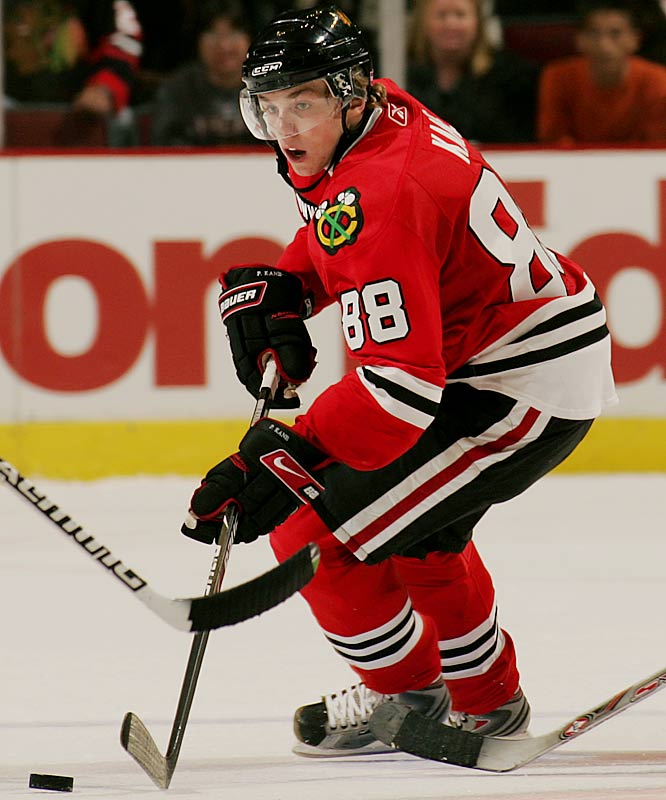
    
PATRICK KANE
     With their first-round playoff series against the Nashville Predators tied at two games apiece, the Hawks are trailing 4-3 in the third period of Game 5 at the United Center and facing the prospect of returning to Nashville for a potential elimination game. The situation goes from bad to worse when Marian Hossa is sent off for boarding with only one minute and three seconds left.     
     As the clock ticks down, Nashville’s Martin Erat gains possession of the puck behind his own net and attempts to clear it along the boards, hoping to spring one of his teammates for a shot at Chicago’s empty net. Patrick Sharp intercepts the puck, pushes it over to Brent Seabrook in the corner, who slides it to Jonathan Toews in the slot. Toews flips a wrist shot that Nashville goalie Pekka Rinne stops with his pads but allows to bounce toward Patrick Kane, who’s camped just to the left of the goal mouth.
     Before you know it, Kane shovels the biscuit into the basket, and the game is tied with 13.6 seconds remaining. It is the first game-tying, shorthanded goal inside the final minute of a playoff game in the long history of the NHL, and it saves the Hawks’ season. The Hawks win 5-4 when Hossa tallies four minutes into overtime, and they advance to the second round by defeating the Predators 5-3 in Game 6 at Nashville.


Game of the Year: Blackhawks vs. Philadelphia Flyers, June 9
    
    
     The home team had won each of the first five games of the Stanley Cup Finals when the Blackhawks and Flyers took the ice for Game 6 in Philadelphia. Patrick Kane assisted on the Hawks’ first goal, by Dustin Byfuglien, and their third, by Andrew Ladd, as Chicago took a 3-2 lead into the third period.
     But the Flyers’ Scott Hartnell scored his second goal of the game with 3:59 remaining in the third period, and neither team scored again in regulation. The Hawks had the better of it all night, peppering Philadelphia goalie Michael Leighton with 41 shots in all, while Antti Niemi faced only 24, but nonetheless the Flyers held on to force overtime.
     Four minutes into the extra period, Kane received the puck from Brian Campbell near the left circle. He fired from an apparently impossible angle between Leighton's pads and deep into the far side of the net. The Hawks were Stanley Cup champions, but for an awkward stretch of time no one other than Kane knew it—because only Kane was certain that the puck was in the net (actually it had become lodged under the net). "I knew it was in right away," Kane said. "It was crazy. At that moment, it's just like 'We won the Stanley Cup.'"
     Kane single-handedly began the celebration, skating the length of the ice, yelling "It's in and the game's over!" as he passed the Hawks' bench, and jumping into the arms of Niemi, while the Flyers and their fans looked on in stupefied silence. Almost a minute elapsed before the officials finally confirmed that Kane indeed had scored and that the Hawks’ 49-year Stanley Cup drought was over. 


Player of the Year: Jonathan Toews, Blackhawks

JONATHAN TOEWS
     Wearing the "C" that signifies a team captain is an honor and status symbol for hockey players that is unlike any in other sports. In order to wear it effectively, one must be among the best players on the team, must have the respect of his coach and teammates, and must be able to act as the team's leader both vocally and by example.
    Jonathan Toews was named captain of the Blackhawks in the summer of 2008 after only one season in the NHL and just three months after his 20th birthday. His dedication to the job has earned him the nickname "Captain Serious." In 2010, Captain Serious led the Blackhawks to the Stanley Cup championship and received the Conn Smythe Award as the most valuable player of the playoffs.
     "He is a special player," head coach Joel Quenneville said of Toews during the Hawks' playoff run. "Exactly the same approach over the course of the year to the end of the year. He rises to the occasion. But his consistency is what we like. I think Johnny represents exactly the type of leadership any team would love to have."

Honorable Mention (in alphabetical order):
Patrick Kane, Blackhawks; Duncan Keith, Blackhawks; Paul Konerko, White Sox; Julius Peppers, Bears; Derrick Rose, Bulls. 

Tuesday, December 28, 2010

In Memoriam, 2010

     We Chicago sports fans lost a few of our favorite performers this year. Heading the list were Bears Hall of Famers Stan Jones and George Blanda, Cubs stars Ron Santo and Phil Cavarretta, and the Blackhawks' Ed Litzenberger, captain of the 1961 Stanley Cup champions.
     Each of the aforementioned gentlemen enjoyed a long and acclaimed career in his sport, lived into his old age, and could look back with satisfaction upon heroic feats of the distant past. Regrettably, the same could not be said of Gaines Adams, the Bears defensive end who was struck down without warning at only 26, while his potential was still unrealized.
     Below is a list of notable Chicago sports personalities who passed away in 2010:

GAINES ADAMS
Gaines Adams, 26, Bears defensive end 2009, All-American at Clemson 2006 (January 17).

Johnny Bailey, 43, Bears running back and kick returner 1990-1991, previously starred at Texas A&I University, inducted into College Football Hall of Fame 2000 (August 20).

Black Tie Affair, 24, Chicago-based thoroughbred, won Equipoise Mile 1990, won Hawthorne Gold Cup 1990, won Washington Park Handicap 1991, Horse of the Year 1991 (July 1).

George Blanda, 83, Bears quarterback and placekicker 1949-1958, later starred with Oakland Raiders, inducted into Pro Football Hall of Fame 1981 (September 27).

Lorn Brown, 71, Bulls broadcaster 1975-1978, White Sox broadcaster 1976-1979 and 1983-1988 (June 24).

Freddie Burdette, 73, Cubs pitcher 1962-1964 (June 1).

Phil Cavarretta, 94, Cubs first baseman/outfielder 1934-1953, Cubs manager 1951-1953, White Sox first baseman 1954-1955, three-time All-Star, played for Cubs in three World Series, National League batting champion and Most Valuable Player 1945 (December 18).

Ray Coleman, 88, White Sox outfielder 1951-1952 (September 19).

Quintin Dailey, 49, Bulls guard 1982-1986 (November 8).

Joe Gates, 55, White Sox second baseman 1978-1979 (March 28).

Billy Hoeft, 77, Cubs pitcher 1965-1966 (March 16).

Ken Holcombe, 91, White Sox pitcher 1950-1952 (March 15).

Lou Jankowski, 78, Blackhawks forward 1953-1955 (March 21).

Stan Jones, 78, Bears offensive guard and defensive tackle 1954-1965, three-time All-Pro, seven-time Pro Bowler, introduced systematic practice of weight training to NFL, member of Bears world champions 1963, inducted into Pro Football Hall of Fame 1991 (May 21).

Ed Litzenberger, 78, Blackhawks right wing 1954-1961 and captain 1958-1961, won Calder Trophy as NHL rookie of the year 1955, captain of Stanley Cup champions 1961 (November 1).

Dick Loepfe, 88, Chicago Cardinals offensive tackle 1948-1949 (October 31).

Bob Probert, 45, Blackhawks left wing 1995-2002 (July 5).

Robin Roberts, 83, Cubs pitcher 1966, better known for his previous tenure with Philadelphia Phillies, inducted into the National Baseball Hall of Fame 1976 (May 6).

Ron Santo, 70, Cubs third baseman 1960-1973, White Sox second baseman 1974, nine-time All-Star, five-time Gold Glove award winner, Cubs broadcaster 1990-2010 (December 3).

Johnny Sellers, 72, jockey 1955-1977, won Washington Park Handicap 1958 and 1960, won Arlington Classic 1960, won American Derby 1960, won Stars & Stripes Handicap 1961, inducted into National Racing Hall of Fame 2007 (July 2).

Bob Shaw, 77, White Sox pitcher 1958-1961, Cubs pitcher 1967, went 18-6 in Sox’ pennant winning-season of 1959, went 1-1 in World Series of same year (September 23).

Solly Sherman, 92, Bears quarterback 1939-1940, passed to Joe Maniaci for one of the Bears’ 73 points (on an extra-point attempt) in legendary 1940 NFL title game victory over Washington Redskins (October 10).

Bobby Thomson, 86, Cubs outfielder 1958-1959, better known for his dramatic pennant-winning home run for New York Giants in 1951 (August 16).

Friday, December 24, 2010

Many Happy Returns

DEVIN HESTER
     The Bears clinched the NFC North Division championship Monday night with an impressive 40-14 victory over the Minnesota Vikings. It marks the Bears' tenth division title since the NFL-AFL merger in 1970, and it would not have been accomplished without Devin Hester, who has rebounded from two subpar seasons to re-establish himself as the best kickoff and punt returner in the game today and as the greatest of all time.
     Hester came into the game, the 74th of his career, tied for the most return touchdowns in league history with Brian Mitchell, who had 13 in 223 games. It looked as though he would break the record when he got free on the opening kickoff of the second half. Alas, Hester was brought down at Minnesota's six-yard line after toting the ball 79 yards. So close and yet so far.
     But just minutes later, Hester fielded a punt at his own 36-yard line and took it to the house. It was the 14th return touchdown of his career, confirming him as the most proficient return man in history. Hester needed just 286 attempts to set the record, compared to 1,070 by Mitchell.
     "Right now, [Hester] is a Hall of Famer," said former All-Pro return man Deion Sanders. "I can't think of a returner ever playing the game with the impact he has. There is none."
     Well said, Deion. Hester's impact goes well beyond the touchdowns he scores. It also is felt in the field position he provides by his returns and when opponents sacrifice yardage by trying to kick away from him. His mere presence on the field is enormously disruptive to the Bears' opponents.
     Hester is a respectful, humble man, and after breaking the record he sought to deflect credit away from himself and toward the ten Bears special-teamers who accompany him on his jaunts toward paydirt. "I'm just glad that God put me on this team," he said.
     The official record of 14 return touchdowns does not count Hester's return of a missed field goal in 2006 or his electrifying kickoff return to open the 2007 Super Bowl. Even without those two "asterisks," however, Hester's record will never be broken by anyone but a truly great player. And before he is through, he might put the record at a level where it will never be broken, period.

Wednesday, December 22, 2010

Phil Cavarretta, 1916 - 2010

    
PHIL CAVARRETTA
     Phil Cavarretta, who passed away Saturday at the age of 94, was not yet 30 when he played in his third World Series for the Cubs. This was in 1945, and Cavarretta had already appeared in the World Series of 1935 and 1938. Neither he nor anyone else could have known that no Cub would appear in another fall classic for a long, long time.
     Cavarretta joined the Cubs shortly after graduating from Lane Tech High School in 1934, moving two miles east on Addison Street to Wrigley Field. He played seven games for the Cubs in 1934 and was an everyday player in 1935, when he was still 18 years old for the first half of the season. Although he had very little power, especially for a first baseman (he averaged fewer than five homers a year), Cavarretta was an excellent contact hitter who finished his career with a .293 average and more walks than strikeouts. He played 20 seasons for the Cubs and finished up with two for the White Sox.
     Cavarretta earned the National League Most Valuable Player award in 1945 when he hit a league-leading .355 with 94 runs scored and 97 runs batted in. It was no fault of his that the Cubs lost the World Series to the Detroit Tigers in seven games. He homered and scored three runs in the Cubs’ 9-0 rout of American League MVP Hal Newhouser in Game 1, and he ended up batting .423 (highest on either team), with seven runs scored and five RBIs for the Series.
     Cavarretta is the last Cub, so far, to hit a World Series home run. He was also the last in a long line of player-managers for the Cubs—which extended back to Cap Anson in 1879, and included Frank Chance, Rogers Hornsby, Charlie Grimm, and Gabby Hartnett. It was Cavarretta who, in 1953, wrote the name of Ernie Banks on the Cubs’ lineup card for the first time. The next year, he became the first manager ever to be fired in spring training, after he bluntly informed Cubs owner P.K. Wrigley that the club had no chance to contend.
     "Phil hated to lose," Cubs outfielder Ralph Kiner said, "and he was very honest, and that was the reason he got fired." The Cubs finished seventh, 33 games off the pace, but being proven right did not get Cavarretta his job back.

Monday, December 20, 2010

Kid K, No Longer a Kid, Returns to Cubs

     When he left the Cubs after the 2008 season, righthander Kerry Wood made no secret of the fact that he hoped to return someday. Someday turned out to be Friday, when free-agent Wood agreed to rejoin the Cubs for one year at $1.5 million, declining several other offers, including one from the New York Yankees that was said to be for two years at $5 million per. For Wood, it clearly isn't about the money as much as it is about being where he and his family prefer to be.
     Wood is following a number of prominent Cubs pitchers of the past (Fergie Jenkins, Ken Holtzman, Rick Reuschel, Greg Maddux, and Jon Lieber) who also returned after playing elsewhere. None of them was as good the second time around, and none could have been realistically expected to be. The same is true of Wood, who was an occasionally unhittable starting pitcher in his heyday, and is now a 33-year-old seventh- or eighth-inning man out of the bullpen.
     When Wood first came on the scene in 1998, he was a pitching prospect unlike any that Cubs fans had seen in many years. Few could have guessed that hed win only 77 games in the first ten years of his career, while suffering through 12 separate stints on the disabled listbut that is what happened.
     Wood was National League Rookie of the Year in 1998, and his future stretched promisingly before him. The highlight of that season, of course, was his sensational 20-strikeout game on May 6, which is described below.


Kerry Wood
     In 1998, Kerry Wood’s babyface made him look even younger than his 20 years of age, but with a baseball in his hand he was a menacing presence. He was six-foot-five and 225 pounds, and his combination of a 100-m.p.h. fastball, devastating curveball, and wicked slider was unprecedented. So was his effort on a drizzly Wednesday afternoon at Wrigley Field, when in just his fifth major-league start, he pitched one of the greatest games of all time.
     From the day he was drafted out of high school in 1995, Wood had been the most highly touted prospect in the Cubs organization. Every scout who saw him in the minor leagues swore he was the real thing, and every team that talked trade with the Cubs asked about him. When, at the close of spring training in 1998, the Cubs decided to send him out for a little more seasoning, Anaheim Angels manager Terry Collins facetiously said he would put all his money on the Cubs to win the World Series. “If they have five [starting] pitchers better than Kerry Wood,” he said, “they’re going all the way!”
     Recalled after just one start at Iowa, Wood went 2-2 with a 5.89 earned-run average in his first four outings for the Cubs, looking brilliant at times and awful at others. Then, on May 6, he faced a Houston Astros club that had won nine of its last ten games and boasted the National League’s most potent offense. He struck out the first five batters. He fanned one more in the third, two in the fourth, and three in the fifth.
     Wood struck out one man in the sixth and struck out the side in the seventh. When he fanned the first batter in the eighth, the bleacher fans who had brought placards to mark each “K” ran out. They had brought 16. Wood struck out the next two Astros as well, whereupon other fans were recruited to augment the placards by lining up and painting K’s on their chests. Wood’s 18 strikeouts surpassed the franchise record, set in 1906, and tied the major-league record for rookies.
     Wood had worked with a scant one-run lead since the second inning, as Houston’s Shane Reynolds held the Cubs in check. The Cubs got an insurance run in the bottom of the eighth. When Wood took the mound for the ninth, the crowd of 15,758 was going wild. Billy Spiers came up to pinch hit for Reynolds. With the crowd chanting Wood’s first name, Spiers struck out. That gave Wood seven strikeouts in a row and 19 for the day. Nineteen strikeouts in one game had been accomplished five times before, including once by Nolan Ryan—Wood’s fellow Texan and his idol, in whose honor the youngster wore number 34. But even Ryan, baseball’s all-time strikeout leader, had never whiffed 20 in a game. Only another Texan, Roger Clemens, had done that—first in 1986 and again in 1996.
     Craig Biggio, the Astros’ excellent leadoff man, strode to the plate. He tapped a soft grounder to shortstop and was roundly booed for having hit the ball. Now both Wood and the Astros were down to their final out. Derek Bell was the hitter. He flailed in vain at two nasty curveballs. A steady roar now replaced the “Ker-ree!” chants. Bell let the next pitch go to make the count 1-and-2. Catcher Sandy Martinez called for another curveball.
     Bell had no chance. He was strikeout victim number 20. Wood pumped his fist once, rather sheepishly, before he was mobbed by his teammates.
     If it wasn’t the greatest single-game pitching performance in history, it was certainly the most dominant. Only two men reached base: one on a scratch single off the glove of third baseman Kevin Orie (which might easily have been ruled an error) and the other when he was hit by a pitch. Only eight pitches were hit into fair territory, just two out of the infield. Houston’s three-four-five hitters—Jeff Bagwell, Jack Howell, and Moises Alou—came to bat a total of nine times and struck out nine times.
     “It was just one of those days,” said Wood. “It just felt like playing catch out there.”