Showing posts with label Ernie Banks. Show all posts

Wednesday, December 8, 2021

Worth a Thousand Words: Buck O'Neil

John Buck ONeil, who was (finally) elected to the National Baseball Hall of Fame this week, became the first Black coach in the major leagues when he signed on with the Cubs in 1962. That was a significant accomplishment in its own right, but it ranks as little more than a footnote when one considers the full sweep of O’Neil’s careerwhich stretched from his first taste of semi-pro ball in 1924 (at age 12) to his retirement as a part-time scout in 2006 (the same year he passed away at 94).

BUCK O'NEIL AS A CUBS COACH.

     Much of O’Neil’s career was spent in the Negro American League, most notably as a player, manager, and executive with the Kansas City Monarchs. In the latter capacity, he helped engineer the Cubs’ acquisition of Ernie Banks from the Monarchs in 1953. He later served as a scout for the Cubs, signing Lou Brock, Oscar Gamble, Lee Smith, and Joe Carter, among others, and acting as a mentor and confidante to Billy Williams.
     In 1994, O’Neil stole the show in Ken Burns’s acclaimed PBS documentary series Baseball. His ebullient personality and riveting stories fascinated millions of people who had never heard of him before.
     Around the same time, he co-founded America’s Negro Leagues Baseball Museum in Kansas City and donated his own personal memorabilia to get the museum started. 
     In 2005, the National Baseball Hall of Fame set up a special committee to select previously overlooked Negro Leagues players and owners for induction. Incredibly, O’Neil did not make the cutbut, generous even to a fault, he showed up on induction day at Cooperstown and spoke eloquently on behalf of the 16 men and one woman who were selected.
     I’m not bitter, O’Neil said at the time. My grandfather was a slave. He was not bitter. I learned that from him. And you know what? I wouldn’t trade my life for anybody’s. 

Check out our book Heydays: Great Stories in Chicago Sports on Amazon.  
 

Friday, September 10, 2021

Chicago Cubs Trophy Case

Kris Bryant and the San Francisco Giants are visiting the Cubs at Wrigley Field this weekend, marking the first time that Bryant has played against his old teammates. When Bryant in 2016 made the most important assist by a Cub since at least 1908, he was in the midst of a streak that saw him win College Player of the Year, Minor League Player of the Year, National League Rookie of the Year, and National League Most Valuable Player in consecutive seasons. It seems fair to doubt whether anyone will ever equal that particular feat again.

KRIS BRYANT
    

Below are some of the noteworthy honors won by Bryant and other Cubs over the years.

Retired Numbers
31 - Greg Maddux 

World Championship Managers
1907 - Frank Chance
1908 - Frank Chance
2016 - Joe Maddon

World Series Most Valuable Player
2016 - Ben Zobrist

National League Most Valuable Player
1911 - Frank "Wildfire" Schulte
1929 - Rogers Hornsby
1935 - Gabby Hartnett
1945 - Phil Cavarretta
1952 - Hank Sauer
1958 - Ernie Banks
1959 - Ernie Banks
1984 - Ryne Sandberg
1987 - Andre Dawson
1998 - Sammy Sosa
2016 - Kris Bryant

The Sporting News Major League Player of the Year
1972 - Billy Williams
1984 - Ryne Sandberg
1998 - Sammy Sosa

National League Cy Young Award
1971 - Fergie Jenkins
1979 - Bruce Sutter
1984 - Rick Sutcliffe
1992 - Greg Maddux
2015 - Jake Arrieta

National League Rookie of the Year
1961 - Billy Williams
1962 - Ken Hubbs
1989 - Jerome Walton
1998 - Kerry Wood
2008 - Geovany Soto

2015 - Kris Bryant

National League Batting Champion
1876 - Ross Barnes
1879 - Cap Anson
1880 - George Gore
1881 - Cap Anson
1886 - King Kelly
1887 - Cap Anson
1888 - Cap Anson
1912 - Heinie Zimmerman
1945 - Phil Cavarretta
1975 - Bill Madlock
1976 - Bill Madlock
1980 - Bill Buckner
2005 - Derrek Lee

National League Home Run Leader
1884 - Ned Williamson
1885 - Abner Dalrymple
1888 - Jimmy Ryan
1890 - Walt Wilmot
1910 - Frank "Wildfire" Schulte
1911 - Frank "Wildfire" Schulte
1912 - Heinie Zimmerman
1916 - Cy Williams
1926 - Hack Wilson
1927 - Hack Wilson
1928 - Hack Wilson
1930 - Hack Wilson
1943 - Bill Nicholson
1944 - Bill Nicholson
1952 - Hank Sauer
1958 - Ernie Banks
1960 - Ernie Banks
1979 - Dave Kingman
1987 - Andre Dawson
1990 - Ryne Sandberg
2000 - Sammy Sosa
2002 - Sammy Sosa
 

National League Runs Batted In Leader
1876 - Deacon White
1880 - Cap Anson
1881 - Cap Anson
1882 - Cap Anson
1884 - Cap Anson
1885 - Cap Anson
1886 - Cap Anson
1888 - Cap Anson
1891 - Cap Anson
1906 - Harry Steinfeldt
1911 - Frank "Wildfire" Schulte
1912 - Heinie Zimmerman
1929 - Hack Wilson
1930 - Hack Wilson
1943 - Bill Nicholson
1944 - Bill Nicholson
1952 - Hank Sauer

1958 - Ernie Banks
1959 - Ernie Banks
1987 - Andre Dawson
1998 - Sammy Sosa
2018 - Javier Baez

National League Leader in Victories
1876 - Al Spalding
1881 - Larry Corcoran
1885 - John Clarkson
1887 - John Clarkson
1890 - Bill Hutchison
1891 - Bill Hutchison
1892 - Bill Hutchison
1909 - Mordecai Brown
1912 - Larry Cheney
1918 - Hippo Vaughn
1920 - Grover Alexander
1927 - Charlie Root
1929 - Pat Malone
1930 - Pat Malone
1932 - Lon Warneke
1938 - Bill Lee

1964 - Larry Jackson
1971 - Fergie Jenkins
1987 - Rick Sutcliffe

1992 - Greg Maddux
2015 - Jake Arrieta
2018 - Jon Lester
2020 - Yu Darvish

National League Leader in Earned-Run Average
1882 - Larry Corcoran
1898 - Clark Griffith
1902 - Jack Taylor
1906 - Mordecai Brown
1907 - Jack Pfiester
1910 - King Cole
1918 - Hippo Vaughn
1919 - Grover Alexander
1920 - Grover Alexander
1932 - Lon Warneke
1938 - Bill Lee
1945 - Ray Prim
2016 - Kyle Hendricks

National League Leader in Strikeouts
1880 - Larry Corcoran
1885 - John Clarkson
1887 - John Clarkson
1892 - Bill Hutchison
1909 - Orval Overall
1918 - Hippo Vaughn
1919 - Hippo Vaughn
1920 - Grover Alexander
1929 - Pat Malone

1938 - Clay Bryant

1955 - Sam Jones
1956 - Sam Jones
1969 - Fergie Jenkins

2003 - Kerry Wood

National League Manager of the Year
1984 - Jim Frey
1989 - Don Zimmer
2008 - Lou Piniella
2015 - Joe Maddon


Check out our book Heydays: Great Stories in Chicago Sports on Amazon.  

Thursday, April 1, 2021

Cubs Opening Day Honor Roll

Opening Day is upon us, and so (thank heaven) is the prospect of a full 162-game schedule and in-person attendance by the faithful. The Cubs seem to be in a transitional phase between the would-be dynasty that produced the long-awaited world championship of 2016 and whatever comes next. Their pennant prospects seem a little shaky--but hope springs eternal in the hearts and minds of Cubs fans, and never more so than on Opening Day.
     
ERNIE BANKS

We've taken a look back at season openers of the past to compile the Cubs' All-Opening Day roster. Ernie Banks made 17 consecutive Opening Day starts for the Cubs between 1954 and 1970, eight at shortstop and nine at first base.
Anthony Rizzo will tie Mr. Cub at first base during this afternoon's game, while still having a ways to go to catch Charlie Grimm and Mark Grace

BILLY WILLIAMS
    

Billy Williams
had 14 Opening Day starts at four positions: ten in left field, two in right field, one in center field, and one at first base. Ryne Sandberg also made 14 Opening Day starts, one at third base and 13 at second base. Ron Santo started 13 consecutive Opening Days for the Cubs at third base.
    
RYNE SANDBERG

The lists below reflect Cubs Opening Day lineups from 1901 through 2020. Asterisks indicate consecutive years.

Most Opening Day starts (any position)
  1. Ernie Banks, 17* (1954-1970)
  2. Billy Williams, 14* (1961-1974)
 
3. Ryne Sandberg, 14 (1982-1997) 
  4. Ron Santo, 13* (1961-1973)
  5. Five players tied with 12

RON SANTO

Most Opening Day starts by position

  P. Fergie Jenkins, 7 (1967-1983)
  C. Gabby Hartnett, 12 (1922-1938)
1B. Charlie Grimm, 12* (1925-1936)
1B. Mark Grace, 12* (1989-2000)
2B. Ryne Sandberg, 13 (1983-1997)
3B. Ron Santo, 13* (1961-1973) 
SS. Shawon Dunston, 11 (1985-1997)
LF. Billy Williams, 10 (1962-1973)
CF. Andy Pafko, 7 (1944-1951)
RF. Sammy Sosa, 12* (1993-2004)

Second most Opening Day starts by position
  P. Carlos Zambrano, 6* (2005-2010)
  C. Johnny Kling, 7 (1901-1911)
1B.
Ernie Banks, 9* (1962-1970) 
2B. Billy Herman, 10* (1932-1941)
3B. Stan Hack, 12 (1932-1947)
SS. Don Kessinger, 10* (1966-1975)
LF. Riggs Stephenson, 6* (1926-1931)
LF. Alfonso Soriano, 6* (2008-2013)
LF. Jimmy Sheckard, 6 (1906-1912)
CF. Hack Wilson, 6* (1926-1931)
RF. Bill Nicholson, 7 (1941-1948)
RF. Frank "Wildfire" Schulte, 7 (1906-1913)

Third most Opening Day starts by position
  P. Rick Sutcliffe, 5* (1985-1989)
  P. Grover Alexander, 5 (1918-1925)
  P. Charlie Root, 5 (1927-1932)
  C.
Jody Davis, 6* (1983-1988) 
  C. Clyde McCullough, 6 (1941-1954)     
1B. Anthony Rizzo, 8* (2013-2020)
1B. Frank Chance, 8 (1904-1912)
2B. Johnny Evers, 9 (1904-1913)
3B. Aramis Ramirez, 7* (2004-2010)
SS. Joe Tinker, 9 (1902-1912) 
LF. Hack Miller, 4* (1922-1925)
LF. Hank Sauer, 4 (1950-1955)
LF. Kyle Schwarber, 4 (2016-2020)
CF. Rick Monday, 5* (1972-1976)
CF. Jimmy Slagle, 5 (1902-1908)
RF. Andre Dawson, 5 (1987-1992)
RF. Max Flack, 5 (1916-1921)


Check out our book Heydays: Great Stories in Chicago Sports on Amazon. 

Sunday, February 28, 2021

'Twas Fifty Years Ago: Chicago Sports Memories of 1971

 In 1971, two of the all-time great Chicago athletes called it a career within three weeks of each other. Ernie Banks played the last of his 2,528 games for the Cubs on September 26, and Gale Sayers played the last of his 68 games for the Bears on October 17.

GALE SAYERS 
 
Sadly, both players finished up as mere shadows of their former selves. Banks, 40, had only 83 at-bats for the season, hitting .193 with three homers and six runs batted in. Sayers, just 28, played in two games and rushed for 38 yards on 13 carries before conceding that his latest comeback from a succession of knee surgeries had run its course. Neither man would have to wait long for the call to join his sport's hall of fame. 

TONY ESPOSITO

The Blackhawks took an immediate liking to their new home in the NHL's Western Division, where they were the only established franchise among six four-year-old expansion teams. The Hawks won 26 and tied 5 of their first 37 games. They did not lose on home ice until January 6, compiling a home record of 16-0-2 prior to that. They ended up at 49-20-9, racking up 107 points to win the division going away. Mainstays of the club were goalie Tony Esposito, center Stan Mikita, forwards Bobby Hull and Dennis Hull, and defensemen Bill White and Pat "Whitey" Stapleton.
     In the playoffs, the Hawks dispatched the Philadelphia Flyers (four games to none) and the New York Rangers (four games to three) to advance to the Stanley Cup Final against the Montreal Canadiens. The Hawks won the first two games at home, dropped the next two at Montreal, then won again at home--in a 2-0 shutout by Esposito--to draw tantalizingly close to capturing the Cup. But the Canadiens won the next game in Montreal to even the series again.
     In Game 7 at the Stadium on May 18, Dennis Hull tallied in the last minute of the first period on a power play and Danny O'Shea lit the lamp seven minutes into the second to give the Hawks a 2-0 lead. The home team was closing in on the championship, and the old barn was rocking. Alas, the Canadiens scored three unanswered goals--two in the second period and one in the third--to win 3-2. As Montreal captain Jean Beliveau hoisted the Cup, the standing-room-only crowd of heartbroken Hawks fans politely applauded the champions. The trophy that Beliveau held in his hands would remain beyond the Hawks' grasp for 39 more years.
 

CHET WALKER

In their fifth year of existence, the Bulls had their first 50-win season in 1970-71. They played an intense, physical style of ball that mirrored the pugnacious personality of their coach, Dick Motta, and they had the Stadium turnstiles spinning. Forwards Bob Love and Chet Walker were All-Stars, guard Jerry Sloan was named second-team All-Defense, and Motta was voted Coach of the Year. Although the Bulls lost a hard-fought first-round playoff series to the Los Angeles Lakers in seven games, with the home team winning each game, the future was still bright. They won 50 or more games in each of the next three seasons, and they proved that a pro basketball franchise could not only survive but thrive in Chicago.
 
FERGIE JENKINS

The Cubs plodded to an 83-79 mark in Banks's 19th and final season, finishing tied for third place in the National League East, 14 games behind the Pittsburgh Pirates. The lanky 28-year-old righthander Fergie Jenkins went 24-13 with a 2.77 earned-run average and 277 strikeouts to earn the Cy Young Award. It was the fifth of six consecutive seasons in which Jenkins won 20 or more games. Jenkins was joined at the All-Star Game by second baseman Glenn Beckert, shortstop Don Kessinger, and third baseman Ron Santo. (Jenkins and Santo were among 19 future Hall of Famers who played in the ’71 midsummer classic, the most star-studded baseball game of all time.)
     A late-season clubhouse meeting almost turned into a free-for-all when manager Leo Durocher made some comments about Santo that caused the latter to attack him. After Santo was restrained and order restored, first baseman Joe Pepitone and pitcher Milt Pappas also got earfuls from Durocher, who then threatened to quit but was talked out of it by general manager John Holland.

WILBUR WOOD

Having bottomed out with a 56-106 record the year before, the White Sox welcomed a new manager, Chuck Tanner, a new broadcaster, Harry Caray, and a return to respectability. The Sox finished at 79-83, and attendance at Comiskey Park nearly doubled. Tanner and pitching coach Johnny Sain converted knuckleballing lefty reliever Wilbur Wood into a starter, and the experiment proved a success, to say the least. Wood went 22-13 with a 1.91 ERA while logging 334 innings. He finished third in Cy Young balloting and established himself as the South Siders' ace for the next several years. Wood and 25-year-old third baseman Bill Melton, who led the American League (and tied his own club record) with 33 home runs, represented the Sox in the All-Star Game.


DICK BUTKUS

After several years of mediocrity, the Bears galvanized fans by winning six of their first nine games. On November 14 against the Washington Redskins, a 40-yard touchdown run by Cyril Pinder tied the score 15-15 late in the fourth quarter. On the extra-point attempt, the snap went awry, but holder Bobby Douglass (also the Bears' quarterback) picked up the ball, scrambled around a while, and then fired a strike to Dick Butkus (of all people) in the corner of the end zone to give the Bears a dramatic 16-15 win.
     At 6-3, the Bears seemed headed for the playoffs, but they lost the next five games--four of them by very lopsided scores--to finish 6-8. Head coach Jim Dooley was fired after compiling a record of 20-36 for four seasons. He was replaced by Abe Gibron.
     The Bears' game at Detroit on October 24 was marred by the on-field death of Lions receiver Chuck Hughes from an apparent heart attack.


Check out our book Heydays: Great Stories in Chicago Sports on Amazon.


Monday, February 15, 2021

Minnie Minoso

On May 1, 1951, Orestes “Minnie” Minoso made his debut with the White Sox, thus becoming the first black player to appear in a major-league game for a Chicago team (almost three full seasons before Ernie Banks and Gene Baker joined the Cubs). 
 
 
MINNIE MINOSO
 
“I’m the first guy to bat,” Minoso recalled years later. “First pitch comes right over the plate and I hit a home run to center field. The people who wanted to boo me didn’t get a chance. But later they got a chance. The bases were loaded and I was playing third base. A hit bounced off the bag and hit my ankle, then went through my legs. I was charged with an error, and two runs scored. My first game on the White Sox I was at the top and then sunk to the bottom. Same day, good and bad.”
As time went on, there was a lot more good than bad. In his first seven years, Minoso hit over .300 five times, knocked in 100 or more runs three times, and led the league in stolen bases three times. His aggressive style ignited the Go-Go White Sox, and he became the most popular player on the South Side. But then he was traded to Cleveland, and he missed the pennant year of 1959.
Minoso returned to the White Sox in 1960. A record opening-day crowd of 41,661 at Comiskey Park gave him a hero’s welcome, and he gave them their money’s worth. A more eventful day would have been difficult to imagine.
In the first inning, Minoso beat out a bunt for an apparent base hit but was called out for running outside the baseline. A lengthy rhubarb ensued.
In the second, he hit a screaming liner and was robbed on a circus catch by Kansas City center fielder Bill Tuttle; he was credited with a sacrifice fly when Luis Aparicio scored on the play.
In the fourth, Minoso hit a grand slam. In the fifth, playing left field, he narrowly missed colliding with Aparicio as both men chased a pop fly; he dropped the ball for an error.
In the seventh, he raced into the left-center field gap to spear a line drive that would have scored two runs.
In the top of the ninth, with the score tied 9-9, he threw out the go-ahead runner at the plate. In the bottom of the ninth, he belted another home run to win the game. 
Minnie was back, as his two home runs, six runs batted in, two sensational defensive plays, and countless ovations from the crowd amply demonstrated. “I’m comfortable here,” he said after the game. “I was here before and I feel like this is my home.” 
 
Born in Havana, Cuba, Minoso was the first significant Latin American star in major league history. He finished second in voting for the American League Rookie of the Year in 1951. He finished fourth in voting for Most Valuable Player in 1951, 1953, 1954, and 1960. He won three Gold Gloves and was a nine-time All-Star.
Minoso played for the White Sox from 1951 through 1958 and 1960 through 1961 before seemingly ending his career back with the South Siders in 1964. But Bill Veeck, ever on the lookout for marketing stunts, put Minoso on the active roster in his second go-round as Sox owner from 1976 to 1980. Minoso got one hit in eight at-bats in 1976 at the admitted age of 50 (many people suspected that he was older), and he went o-for-2 in 1980.
Minnie remained a constant presence at White Sox home games through the 2014 season. He passed away during spring training in 2015.
 
  
Check out our book Heydays: Great Stories in Chicago Sports on Amazon.  


Friday, January 22, 2021

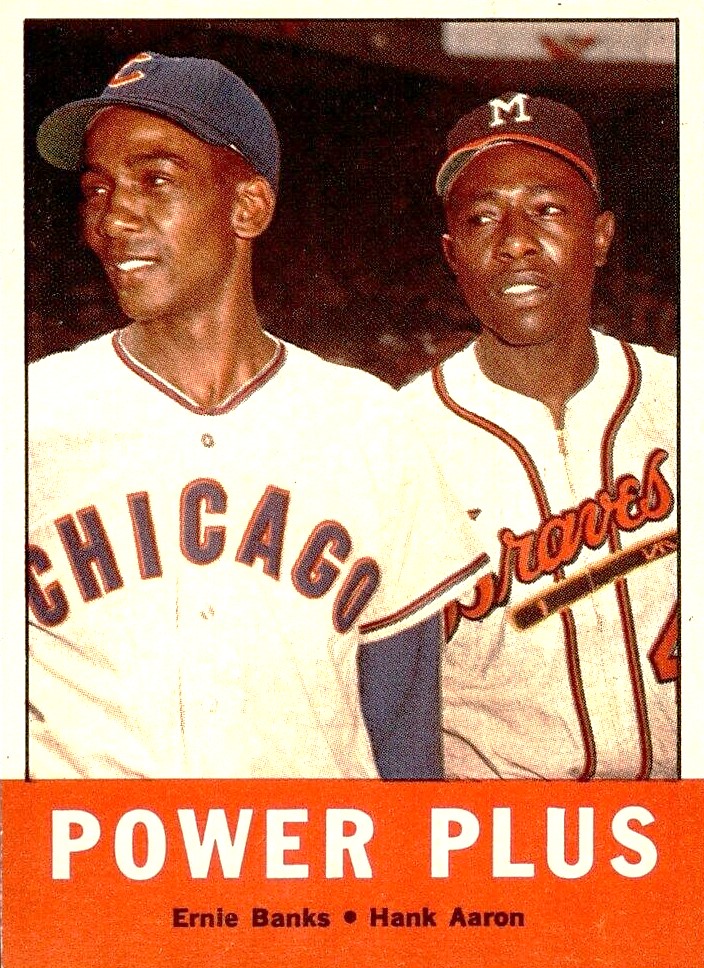
Worth a Thousand Words: Ernie Banks and Hank Aaron

Both during their careers and long after, Hank Aaron and Ernie Banks were dear friends. Aaron showed up for the dedication of Ernie's statue at Wrigley Field in 2008, and he was a pallbearer (along with fellow Hall of Famers Billy Williams and Fergie Jenkins) at Mr. Cub's funeral in 2015. We'd like to say a few words about Aaron on the occasion of his passing at the age of 86.
    
A SPECIAL TOPPS BASEBALL CARD FROM 1963.

Aaron's record more than speaks for itself. Even after the steroid-fueled offensive explosion of recent decades, Hammerin' Hank still ranks first all-time in extra-base hits, runs batted in, and total bases. He ranks second in home runs, third in games played and hits. He played in 25 All-Star Games and was elected to the Hall of Fame in his first year of eligibility
with 98 percent of the votes. (What were the other two percent thinking?)
     "I never doubted my ability," Aaron once said, "but when you hear all your life that you're inferior, it makes you wonder if the other guys have something you've never seen before. If they do, I'm still looking for it."
     Aaron was reluctant to toot his own horn throughout his career, but after his playing days he was more outspoken about the racism he faced coming up and about the progress or lack thereof he saw over the years. His contributions to our national game both on and off the field and his unceasing class in every situation will never be forgotten.  
 
 Check out our book Heydays: Great Stories in Chicago Sports on Amazon.