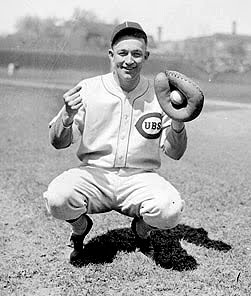
Showing posts with label Gabby Hartnett. Show all posts

Thursday, April 1, 2021

Cubs Opening Day Honor Roll

Opening Day is upon us, and so (thank heaven) is the prospect of a full 162-game schedule and in-person attendance by the faithful. The Cubs seem to be in a transitional phase between the would-be dynasty that produced the long-awaited world championship of 2016 and whatever comes next. Their pennant prospects seem a little shaky--but hope springs eternal in the hearts and minds of Cubs fans, and never more so than on Opening Day.
     
ERNIE BANKS

We've taken a look back at season openers of the past to compile the Cubs' All-Opening Day roster. Ernie Banks made 17 consecutive Opening Day starts for the Cubs between 1954 and 1970, eight at shortstop and nine at first base.
Anthony Rizzo will tie Mr. Cub at first base during this afternoon's game, while still having a ways to go to catch Charlie Grimm and Mark Grace

BILLY WILLIAMS
    

Billy Williams
had 14 Opening Day starts at four positions: ten in left field, two in right field, one in center field, and one at first base. Ryne Sandberg also made 14 Opening Day starts, one at third base and 13 at second base. Ron Santo started 13 consecutive Opening Days for the Cubs at third base.
    
RYNE SANDBERG

The lists below reflect Cubs Opening Day lineups from 1901 through 2020. Asterisks indicate consecutive years.

Most Opening Day starts (any position)
  1. Ernie Banks, 17* (1954-1970)
  2. Billy Williams, 14* (1961-1974)
 
3. Ryne Sandberg, 14 (1982-1997) 
  4. Ron Santo, 13* (1961-1973)
  5. Five players tied with 12

RON SANTO

Most Opening Day starts by position

  P. Fergie Jenkins, 7 (1967-1983)
  C. Gabby Hartnett, 12 (1922-1938)
1B. Charlie Grimm, 12* (1925-1936)
1B. Mark Grace, 12* (1989-2000)
2B. Ryne Sandberg, 13 (1983-1997)
3B. Ron Santo, 13* (1961-1973) 
SS. Shawon Dunston, 11 (1985-1997)
LF. Billy Williams, 10 (1962-1973)
CF. Andy Pafko, 7 (1944-1951)
RF. Sammy Sosa, 12* (1993-2004)

Second most Opening Day starts by position
  P. Carlos Zambrano, 6* (2005-2010)
  C. Johnny Kling, 7 (1901-1911)
1B.
Ernie Banks, 9* (1962-1970) 
2B. Billy Herman, 10* (1932-1941)
3B. Stan Hack, 12 (1932-1947)
SS. Don Kessinger, 10* (1966-1975)
LF. Riggs Stephenson, 6* (1926-1931)
LF. Alfonso Soriano, 6* (2008-2013)
LF. Jimmy Sheckard, 6 (1906-1912)
CF. Hack Wilson, 6* (1926-1931)
RF. Bill Nicholson, 7 (1941-1948)
RF. Frank "Wildfire" Schulte, 7 (1906-1913)

Third most Opening Day starts by position
  P. Rick Sutcliffe, 5* (1985-1989)
  P. Grover Alexander, 5 (1918-1925)
  P. Charlie Root, 5 (1927-1932)
  C.
Jody Davis, 6* (1983-1988) 
  C. Clyde McCullough, 6 (1941-1954)     
1B. Anthony Rizzo, 8* (2013-2020)
1B. Frank Chance, 8 (1904-1912)
2B. Johnny Evers, 9 (1904-1913)
3B. Aramis Ramirez, 7* (2004-2010)
SS. Joe Tinker, 9 (1902-1912) 
LF. Hack Miller, 4* (1922-1925)
LF. Hank Sauer, 4 (1950-1955)
LF. Kyle Schwarber, 4 (2016-2020)
CF. Rick Monday, 5* (1972-1976)
CF. Jimmy Slagle, 5 (1902-1908)
RF. Andre Dawson, 5 (1987-1992)
RF. Max Flack, 5 (1916-1921)


Check out our book Heydays: Great Stories in Chicago Sports on Amazon. 

Sunday, October 4, 2020

Gabby Hartnett's Homer in the Gloamin'

Gabby Hartnett had the best seat in the house for two of the most celebrated events in baseball history. He was the catcher when Babe Ruth hit his notorious “called shot” in the 1932 World Series and when Carl Hubbell struck out five future Hall of Famers in succession in the 1934 All-Star Game. Hartnett had plenty of unforgettable moments behind the plate during his splendid 20-year career. But it was what he did at the plate one afternoon with darkness falling that ranked as the greatest thrill of his life. 

On September 28, 1938, the Cubs were a half game behind the Pittsburgh Pirates for the National League lead with five games left to go. It was a gloomy afternoon at Wrigley Field. The Cubs trailed the Pirates 3-1 when Hartnett opened the bottom of the sixth with a double to center. Rip Collins followed with a double off the right-field wall to score Hartnett. Collins advanced to third on a single by Billy Jurges and scored the tying run on a forceout. The Cubs missed a chance to go ahead when Jurges, trying to score from second on a single to left-center, was thrown out at the plate by shortstop Arky Vaughn                                                                                            
     The skies continued to darken as the game remained tied through the seventh. In the eighth, the Pirates scored twice, and only an inning-ending double play prevented further damage.
Leading 5-3, the Pirates needed only six more outs to seriously damage the Cubs pennant hopes. But the Cubs came right back in their half of the eighth. Collins led off with a single. Bill Swift relieved Pirates starter Bob Klinger and walked Jurges. Tony Lazzeri was sent up to bunt the runners to second and third. His first attempt was foul. He missed the second pitch altogether, but the ball got away from catcher Al Todd, and Collins went sliding into third. Lazzeri, having failed to sacrifice, then swung away and delivered a double to right, scoring Collins and sending Jurges to third.
The tying and lead runs were now in scoring position for the Cubs. After Stan Hack drew an intentional walk to load the bases, Billy Herman singled to right. The fans were delirious—for an instant. Herman’s hit scored Jurges with the tying run, but Joe Marty (pinch running for Lazzeri) was out at the plate on a perfect throw by right fielder Paul Waner. Now Hack was on second with the go-ahead run, and Herman on first. But Mace Brown came on to pitch for the Pirates and induced Frank Demaree to tap into a double play to end the inning.
By now it was very dark (it would be 50 more years before lights were installed at Wrigley Field). The umpires conferred and decided to let the teams play one more inning, after which it would certainly be impossible to continue.
Charlie Root, the Cubs’ sixth pitcher of the day, got through the ninth unscathed, thanks in part to Hartnett, who nailed Paul Waner trying to steal second for the third out. In the bottom half of the inning, Phil Cavarretta hit a long drive to center that was caught by Lloyd Waner. Then Carl Reynolds grounded out to the second baseman. One more out and the game would go into the books as a tie, and the teams would have to play a doubleheader the next day, with the Cubs needing a sweep to move into first place. 
 
HARTNETT ESCORTED OFF THE FIELD BY USHERS.

Up to the plate strode Hartnett. “I swung once and missed,” he later recalled. “I swung again, and got a piece of it, but that was all. I had one more chance. Mace Brown wound up and let fly; I swung with everything I had and then I got that feeling you get when the blood rushes out of your head and you get dizzy.”
“Hartnett swung,” Paul Waner remembered, “and the damn ball landed in the left-field seats! I could hardly believe my eyes. The game was over, and I should have run into the clubhouse. But I didn’t. I just stood out there in right field and watched Hartnett circle the bases, and take the lousy pennant with him. I just watched and wondered, sort of objectively, you know, how the devil he could ever get all the way around to touch home plate.”
Hartnett’s home run gave the Cubs a 6-5 victory. There was pandemonium in the stands and on the field. “When I got to second base I couldn’t see third for the players and fans there,” Hartnett said. “I don’t think I walked a step to the plate—I was carried in. But when I got there I saw [umpire] George Barr taking a good look. He was going to make sure I touched that platter.”
“The crowd was in an uproar,” said Waner, “absolutely gone wild. They ran onto the field like a bunch of maniacs, and his teammates and the crowd and all were mobbing Hartnett, and piling on top of him, and throwing him up in the air, and everything you could think of. I’ve never seen anything like it.”
It took dozens of Andy Frain ushers, as well as the entire complement of Cub players, to protect Hartnett from the hundreds of fans who had swarmed onto the field. The ushers and the other players tugged and shoved and elbowed their way through the mob to the Cubs’ clubhouse.
For the first time since July 12, Pittsburgh was out of first place. The next day, the Cubs routed the demoralized Pirates 10-1 for their tenth straight win and their 20th in the last 23 games. Appearing on the mound for the fifth time in a week (including three complete-game victories and two relief stints), Bill Lee had an easy time of it as he went the distance. “The heart was gone out of Pittsburgh,” Hartnett said. 
Two days later, the Cubs clinched the pennant with a victory at St. Louis. It was their fourth flag in the past ten seasons, each coming at three-year intervals. 
 

Check out our book Heydays: Great Stories in Chicago Sports on Amazon. 


Tuesday, September 27, 2011

The Day Before the Day

    
DIZZY DEAN
     On September 27, 1938, the newspapers and the radio were full of news about the Munich Conference, where Great Britain and France were in the process of handing Czechoslovakia over to Nazi Germany. A second world war was not yet regarded as inevitable.
     At Wrigley Field, only the National League pennant hung in the balance. Under recently appointed player/manager Gabby Hartnett, the Cubs had surged from far back in the standings to draw within striking distance of the league-leading Pittsburgh Pirates.
     The Cubs had won seven in a row and 17 of their last 20 to advance within a game and a half of the Pirates, who were also surging, having won eight of their last 10. “If we win five of our remaining seven games,” said Pittsburgh manager Pie Traynor, “it doesn’t matter how many the Cubs win.”
     For the opener of the three-game series that would all but decide the pennant, the Cubs turned to Dizzy Dean. Several years earlier, Dean had said, “Anybody who’s had the pleasure of seeing me play knows that I am the greatest pitcher in the world.” Indeed, he averaged 24 wins a year for five years beginning in 1932.
     But the Dizzy Dean who was acquired from St. Louis before the 1938 season was just a shadow of his former self. In the previous summer’s All-Star Game, a line drive had shattered the little toe on his left foot. Because the Cardinals were in a tight pennant race, Dean had continued to pitch, altering his delivery to favor the broken toe. He had ruined his arm in the process.
     For the Cubs, Dean was able to pitch only occasionally, but he always gave his team an honest effort—and a full house. He had not started in five weeks when Hartnett gave him the ball for this “must” game. “In a spot such as this,” Warren Brown wrote in the Tribune, “Dizzy Dean was perfectly at home. Here was a park packed with pop-eyed fans. Here was a game on which the entire season might depend. If you had asked Dean—and many did—what he thought about being put on such a spot, Diz had but one answer: ‘Gabby’s getting smarter every day. Who else would he pick to beat these guys but old Diz?’”
     “His arm was hurting him badly,” teammate Phil Cavarretta recalled. “The thing I remember best watching this man pitch, his presence on that mound encouraged us to go out there and play hard. Watching him pitch was an inspiration. You could see the man was suffering out there. You’d say, ‘My God, let’s go out and win it for Diz.’”
     Getting by on guts and guile, Dean held the Pirates scoreless for eight and two-thirds innings before running out of gas. As he left the field, a tumult of cheers rang down from the standing-room-only crowd of 42,238. “It was an incredible performance,” said Cavarretta. Dean’s teammates congratulated him in the dugout, but he was disgusted that he hadn’t been able to finish.
     With the Cubs clinging to a 2-0 lead and the tying runs on second and third, the ubiquitous Bill Lee relieved Dean. Lee had logged a complete-game victory just 24 hours earlier, and would end up 22-9 for the season with a league-leading 2.44 earned run average and nine shutouts. If the Cy Young Award had existed in 1938, Lee would have won it. As it was, he finished second in voting for the Most Valuable Player award.
     Pirates catcher Al Todd was up to bat. Lee's first offering to Todd was a wild pitch, scoring one run and moving the tying run to third. Then, with the crowd roaring its approval, he struck out Todd—the only strikeout of the game on either side—to narrowly preserve a 2-1 victory. It was Dean’s seventh win of the year against only one loss.
     The Cubs were now only a half game behind the Pirates, and the stage was set for perhaps the most dramatic game ever played at Wrigley Field. That game featured Hartnett's unforgettable “Homer in the Gloamin’,” which put the Cubs in first place to stay.

Reprinted from Heydays: Great Stories in Chicago Sports

Wednesday, October 6, 2010

The "Called Shot"

CHARLIE ROOT
     In Game 3 of the 1932 World Series at Wrigley Field, Babe Ruth of the New York Yankees strode to the plate in the fifth inning under a barrage of lemons and other objects thrown from the stands and a hail of verbal abuse from the Cubs’ dugout. Bad blood had been stirred up between the two clubs over the Cubs’ decision to award shortstop Mark Koenig, a former Yankee, only a partial share of their World Series money because he had not played the entire season for the Cubs. Koenig had made key contributions to Chicago’s pennant drive, and Ruth, among others, was outspoken in his belief that the decision was petty and unjust—although those weren’t the exact words he used.
     The mighty Yankees had a 2-0 lead in the Series. The game was tied 4-4. Homers by Ruth and Lou Gehrig off Cubs ace Charlie Root had given New York an early 4-0 lead, but the Cubs had come back to knot it up in the fourth. When Ruth came up again in the fifth, the crowd and the Cubs’ bench were in an uproar.
     Root threw the first pitch for a called strike, then threw two balls. His next pitch was another called strike, and the jeering from the crowd grew louder. At this point Ruth made an ambiguous gesture with his index finger (or was it his middle finger?). Was he pointing toward the Cubs’ dugout, toward Root, or toward the center-field bleachers? Cubs catcher Gabby Hartnett thought he heard Ruth say, “It only takes one to hit it.” Gehrig, who was in the on-deck circle, remembered it this way: “Babe was jawing with Root and what he said was, ‘I’m going to knock the next pitch down your goddamned throat.’”
     The next pitch was low and away. Ruth swung and hit a tremendous home run into the center-field stands—reportedly the longest ever hit at Wrigley Field to that time. Some in the crowd sat in stunned silence, while others (including presidential candidate Franklin D. Roosevelt) cheered. Gehrig followed with another home run of his own, and the Yankees went on to sweep the Cubs, four games to none. “We should have gone home after winning the pennant,” Cubs second baseman Billy Herman said. “The World Series was a disaster.”
     Had Ruth really called his shot? Most newspaper accounts of the game made no mention of it, and Ruth himself neither confirmed nor denied it until much later, by which time the event had become so ingrained in baseball mythology that there was no turning back. Then he said, “Well, I guess the good Lord was with me.”
     For his part, Charlie Root swore until his dying day that Ruth had never pointed to the seats. If he had, said Root, “I’d have put one in his ear and knocked him on his ass.”

Reprinted from Heydays: Great Stories in Chicago Sports
(c) 2009, 2010 by Christopher Tabbert.

Tuesday, September 28, 2010

The Homer in the Gloamin'

 
GABBY HARTNETT NEARS HOME PLATE AFTER HIS GAME-WINNING HOME RUN.

Seventy-two years ago today, on September 28, 1938, the Cubs and the Pittsburgh Pirates met in perhaps the most dramatic game ever played at Wrigley Field. The Cubs were finishing fast under player/manager Gabby Hartnett, and they had sliced Pittsburgh's lead in the National League pennant race to but half a game. What happened next was, in Hartnett's words, “the greatest thrill of my life.”

     On the gloomy afternoon of September 28, the Cubs trailed 3-1 when Gabby Hartnett opened the bottom of the sixth with a double to center. Rip Collins followed with a double off the right-field wall to score Hartnett. Collins advanced to third on a single by Billy Jurges and scored the tying run on a forceout. The Cubs missed a chance to go ahead when Jurges, trying to score from second on a single to left-center, was thrown out at the plate by shortstop Arky Vaughan.
     The skies continued to darken as the game remained tied through the seventh. In the eighth, the Pirates scored twice, and only an inning-ending double play prevented further damage.
     Leading 5-3, the Pirates needed only six more outs to all but knock the Cubs out of the pennant race. But the Cubs came right back in their half of the eighth. Collins led off with a single. Bill Swift relieved Pirates starter Bob Klinger and walked Jurges. Tony Lazzeri was sent up to bunt the runners to second and third. His first attempt was foul. He missed the second pitch altogether, but the ball got away from catcher Al Todd, and Collins went sliding into third. Lazzeri, having failed to sacrifice, then swung away and delivered a double to right, scoring Collins and sending Jurges to third.
     The tying and lead runs were now in scoring position for the Cubs. After Stan Hack drew an intentional walk to load the bases, Billy Herman singled to right. The fans were delirious—for an instant. Herman’s hit scored Jurges with the tying run, but Joe Marty (pinch running for Lazzeri) was out at the plate on a perfect throw by right fielder Paul Waner. Now Hack was on second with the go-ahead run, and Herman on first. But Mace Brown came on to pitch for the Pirates and induced Frank Demaree to tap into a double play to end the inning.
     By now it was very dark (it would be 50 more years before lights were installed at Wrigley Field). The umpires conferred and decided to let the teams play one more inning, after which it would certainly be impossible to continue.
     Charlie Root, the Cubs’ sixth pitcher of the day, got through the ninth unscathed, thanks in part to Hartnett, who nailed Paul Waner trying to steal second for the third out. In the bottom half of the inning, Cavarretta hit a long drive to center that was caught by Lloyd Waner. Then Carl Reynolds grounded out to the second baseman. One more out and the game would go into the books as a tie, and the Pirates would still be in first place. The teams would have to play a doubleheader the next day, with the Cubs needing a sweep to move into first place.
     Up to the plate strode Gabby Hartnett. “I swung once and missed,” he later recalled. “I swung again, and got a piece of it, but that was all. A foul and strike two. I had one more chance. Mace Brown wound up and let fly; I swung with everything I had and then I got that feeling you get when the blood rushes out of your head and you get dizzy.”
     “Hartnett swung,” Paul Waner remembered, “and the damn ball landed in the left-field seats! I could hardly believe my eyes. The game was over, and I should have run into the clubhouse. But I didn’t. I just stood out there in right field and watched Hartnett circle the bases, and take the lousy pennant with him. I just watched and wondered, sort of objectively, you know, how the devil he could ever get all the way around to touch home plate.”
     Hartnett’s home run gave the Cubs a 6-5 victory. There was pandemonium in the stands and on the field. “When I got to second base I couldn’t see third for the players and fans there,” Hartnett said. “I don’t think I walked a step to the plate—I was carried in. But when I got there I saw [umpire] George Barr taking a good look. He was going to make sure I touched that platter.”
     “The crowd was in an uproar,” said Waner, “absolutely gone wild. They ran onto the field like a bunch of maniacs, and his teammates and the crowd and all were mobbing Hartnett, and piling on top of him, and throwing him up in the air, and everything you could think of. I’ve never seen anything like it.”
     It took dozens of Andy Frain ushers, as well as the entire complement of Cub players, to protect Hartnett from the hundreds of fans who had swarmed onto the field. The ushers and the other players tugged and shoved and elbowed their way through the mob to the Cubs’ clubhouse. A mailman who had caught the home run came and presented the ball to Hartnett, who gratefully gave him an autographed ball in return.
     For the first time since July 12, Pittsburgh was out of first place. The next day, the Cubs routed the demoralized Pirates 10-1 for their 10th straight win and their 20th in the last 23 games. Appearing on the mound for the fifth time in a week (including three complete game victories and two relief stints), Bill Lee had an easy time of it as he went the distance. “The heart was gone out of Pittsburgh,” Hartnett said. Two days later, the Cubs clinched the pennant with a victory at St. Louis. It was their fourth flag in the past 10 seasons, each coming at three-year intervals.
     On the evening of October 3, thousands of fans greeted the Cubs when their train pulled into the Illinois Central station. The following day, a ticker-tape parade down LaSalle Street drew tens of thousands.

Excerpted from Heydays: Great Stories in Chicago Sports
(c)2009, 2010 by Christopher Tabbert.

Wednesday, September 8, 2010

Stretch Drive

BILLY HERMAN
     On the morning of September 4, 1935, the Cubs had a record of 79-52 and were in third place in the National League, two and a half games behind the St. Louis Cardinals and half a game behind the New York Giants. That afternoon, the Cubs began the most sensational stretch drive in baseball history. “We suddenly got hot,” said second baseman Billy Herman. “I don’t mean just hot—we sizzled! All of a sudden we got the notion that we couldn’t lose.”
     The Cubs won every game of an 18-game homestand.
     “You ever go 75 miles an hour on the highway when everybody else is doing 50?” first baseman Phil Cavarretta said. “That’s how we felt. We passed the Giants and caught up to the Cardinals right at the end of the season. With everything up for grabs, we went into St. Louis for a five-game series.”
     The Cubs needed to win just two of the five games to sew up the pennant. On September 26, an eighth-inning home run by the 19-year-old Cavarretta was all that Lon Warneke needed as he blanked the defending world champions 1-0 for his 20th victory of the year. In the first game of the next day’s doubleheader, Bill Lee bested St. Louis ace Dizzy Dean 6-2 for his 20th victory of the year. Although the pennant was already clinched, the Cubs also took the second game for good measure.
     On the morning of September 28, the Cubs had a record of 100-52. They had won 21 games in a row and were National League champions.
     The Cubs led the league in runs scored, batting average, and earned-run average. Five regulars hit better than .300: catcher Gabby Hartnett (.344 with 91 RBIs), Herman (.341 with a league-leading 227 hits and 57 doubles), right fielder Frank Demaree (.325), left fielder Augie Galan (.314 with a league-leading 133 runs scored and 22 stolen bases), and third baseman Stan Hack (.311). But it was pitching that really made the difference down the stretch. Lee won five games, Larry French five, Warneke four, Charlie Root four, Roy Henshaw two, and Tex Carleton one during the streak. The Cubs allowed three or fewer runs in all but one of the 21 games, and in all but three of those games the starting pitcher also finished.

Reprinted from Heydays: Great Stories in Chicago Sports
(c) 2009, 2010 by Christopher Tabbert

Monday, July 26, 2010

Class of 2010

ANDRE DAWSON
     Andre Dawson was inducted into the National Baseball Hall of Fame yesterday, and in accepting this honor of a lifetime he showed the same dignity, humility, maturity, and gratitude that were constants throughout his 21-year playing career. You can boil it all down to one word: class.
     Dawson broke in with the Montreal Expos as the prototypical five-tool player who could hit for average, hit for power, and run, field, and throw with the best of them. A succession of knee injuries eventually compromised his speed, but nothing ever compromised his furious desire to succeed. Dawson was the National League's Rookie of the Year for Montreal in 1977 and Most Valuable Player for the Cubs in 1987. He was an eight-time All-Star, won eight Gold Gloves, and underwent 12 knee surgeries. “No player in baseball history worked harder, suffered more, or did it better than Andre Dawson,” said teammate Ryne Sandberg, himself a Hall of Famer. “He's the best I've ever seen.”
     Dawson was a true professional who, as they say, played the game the right way. He played hurt, always hustled, never showed anyone up. He didn't boast when he was going good and he didn't make excuses when he was going bad.
     There has been much discussion of the fact that Dawson's Hall of Fame plaque depicts him in a Montreal cap, and Dawson himself expressed some disappointment at not being portrayed in a Cubs cap. “I don't feel a sense of loyalty to either one of those organizations,” said Dawson. “I left both organizations on bitter terms. My love affair was with the Chicago Cub fans. That's why I would prefer to put a Cubs cap on, to represent those fans.”
     A nice sentiment, to be sure, but after all Dawson played 11 years for Montreal and only six for the Cubs, so the decision was pretty clear-cut to Hall of Fame President Jeff Idelson. It also in no way diminishes Dawson's achievements as a Cub or the esteem in which he is held by Cub fans. If it is true--as has been reported--that the Cubs have decided not to retire Dawson's uniform number because of the Expos' cap on his plaque, they should be ashamed of themselves. Either Dawson deserves the honor or he doesn't, but it's hard to see how a picture on a plaque would tilt that equation either way.
     If the Cubs really are pondering whether to retire Dawson's number, they might want to think too about Gabby Hartnett, a Hall of Famer who played 19 years for the Cubs--during which time they won four pennants, one with Hartnett as National League MVP and another with him as player/manager. He was by consensus the greatest catcher in N.L. history prior to 1950.

Wednesday, March 31, 2010

Splendid Seasons: Cubs MVPs, Part 1

We're remembering the 19 Chicago athletes whose splendid seasons have earned them the Most Valuable Player award for their respective leagues. Nine of these players have represented the Cubs, and the first three of them are introduced below.


Wildfire Schulte,
1911

     On the Cubs’ pennant-winning teams of 1906, 1907, 1908, and 1910, right fielder Frank "Wildfire" Schulte was overshadowed by teammates who included the immortal pitcher Mordecai "Three-Finger" Brown and the famed double-play combo of Joe Tinker, Johnny Evers, and Frank Chance. Schulte was adequate in all phases of the game and exceptional in none—until 1911, when he had a year that no one could have predicted. The term “career year” comes to mind. Schulte hit an even .300, belted 21 home runs (along with 30 doubles and 21 triples), scored 105 runs, and drove in 121. He led the league in homers, RBIs, and slugging percentage.
     Although the Cubs finished second to the Giants, Wildfire won the first official National League Most Valuable Player award for his efforts. The trophy was a brand-new car, because the Chalmers Motor Company sponsored the award.
     Schulte’s 21 round trippers marked the first time in modern major-league history that anyone had hit more than 16 in a season. To put the feat in perspective, consider that totals of 10, 12, 7, 10, and 10 had led the league in the five previous seasons. This was, after all, the dead-ball era. Frank “Home Run” Baker of the Philadelphia Athletics, whose nickname (of course) referred to his long-ball prowess, topped the American League with 11 that same year.
     Wildfire soon reverted to the form that made him solid yet unspectacular for 14 of his 15 years in the majors. In the seven years prior to 1911, his best seasonal totals had been 10 homers and 68 RBIs. In the seven years after 1911, his best totals were 13 and 72. He was a .270 hitter for his career.


Rogers Hornsby,
1929

     “Baseball is my life,” said Rogers Hornsby, “the only thing I know and can talk about, my only interest.” He was, as they say today, focused. He didn’t smoke or drink—nor did he read or go to movies, for fear he’d ruin his eyesight. "If you live like I do," Hornsby told teammates, "you can be a great player too."
     Hornsby batted .358 for his career, second only to Ty Cobb in baseball history. He won six straight batting titles for the St. Louis Cardinals from 1920 to 1925, hitting .397 over that span. His single-season mark of .424 in 1924 is an unapproachable standard. But it was not only for his batting feats that Hornsby was exceptional; he was one of the most arrogant, obnoxious personalities the game has ever seen. Despite his incredible ability, he was traded three times in three years after leading St. Louis to the 1926 world championship.
     The 1929 Cubs were Hornsby’s fourth team in four years—and what a team they were! They outscored their opponents by over 200 runs as they breezed to the pennant by 10½ games. Hornsby batted .380, with 229 hits, 47 doubles, 39 homers, 156 runs, and 149 RBIs. Outfielders Hack Wilson (.345, 135 runs, 159 RBIs), Riggs Stephenson (.362, 110 RBIs), and Kiki Cuyler (.360, 43 stolen bases, 111 runs) were other mainstays in the Cubs’ fearsome lineup.
     It was the last great year for Hornsby. In 1930, an ankle injury limited him to 104 at-bats. Wilson’s 191 RBIs established a major-league record that still stands, but the Cubs fell two games short of the Cardinals. In the waning days of the season, Hornsby replaced manager Joe McCarthy (who went on to win eight pennants and seven world championships with the Yankees, but that's another story). The Rajah's managerial tenure of two years was not a success, because, as shortstop Woody English explained, “He expected everybody to be as good as he was.”
     Hornsby was elected to the Hall of Fame in 1942.


Gabby Hartnett,
1935

     The National League’s catcher in the first five All-Star games, Gabby Hartnett contributed mightily to Cub pennants in 1932, 1935, and 1938. His best year was 1935, when he belted 13 homers, drove in 91 runs, and batted .344. Thanks to his deadly throwing arm, he also led the league’s catchers in assists with 77, despite catching only 110 games. Hall of Fame pitcher Burleigh Grimes said Hartnett had "as good an arm as ever hung on a man."
     On September 4, 1935, the Cubs were in third place behind the Cardinals and Giants. They lost only twice thereafter—on the second-to-last and last days of the season. In between they pulled off an unbelievable 21-game winning streak that catapulted them to the pennant. "All of a sudden we got the notion that we couldn’t lose,” said second baseman Billy Herman.
     Hartnett was the team’s heart and soul for 19 years. He batted .297 for his career and caught over 100 games 12 times—leading the league in putouts four times, in assists six times, and in fielding percentage six times. In 1938, he was appointed player-manager shortly after the midpoint of the season, with the Cubs in fourth place. After going 14-15 for the first month under Hartnett, the team surged to a 30-12 record the rest of the way and won another pennant. Manager Hartnett was helped immeasurably by player Hartnett, whose game-winning home run in the dark on September 28 put the Cubs in first place to stay. It remains arguably the greatest moment in Cubs history.
     Hartnett was elected to the Hall of Fame in 1955.