Showing posts with label Rogers Hornsby. Show all posts

Tuesday, March 8, 2011

Cubs WARs

    
DICK ELLSWORTH
     Of the many new statistics introduced to baseball fans over the past decade or two, perhaps the most interesting is WAR (wins above replacement). This stat seeks to measure a player's value to his team by determining the number of wins he was responsible for. A WAR of 5.0, for example, means that the team won five more games with the given player in the lineup than it would have won with an average player in his place.
     Not including 19th-century pitchers who logged complete games and innings pitched that are beyond comprehension today, the highest single-season WAR of all time was Babe Ruth's 14.7 in 1923. The Bambino is also the career leader in WAR with 190.0.
     Among Cubs, the 13.8 figure posted by righthanded pitcher John Clarkson in 1885 is the highest in franchise history. Clarkson went (ready for this?) 53-16 with an earned-run average of 1.85, completed 68 of his 70 starts, tossed 10 shutouts, and worked 623 innings. Clarkson and his fellow pre-1900 hurlers Al Spalding, Bill Hutchinson, and Clark Griffith accounted for six of the top ten single-season WARs in franchise history.
     We have excluded these worthy gentleman from both the single-season and career pitchers' lists below, because comparing their feats to those of pitchers in the so-called modern era (since 1900) is apples to oranges. That leaves us with Dick Ellsworth's 10.3 in 1963 as the highest single-season WAR among Cubs pitchers. The 23-year-old lefty went 22-10 with a 2.11 ERA, completed 19 of his 37 starts, and yielded just 223 hits in 291 innings. At 82-80, the Cubs finished over .500 (barely) for the first time since 1946.
     The highest WAR ever recorded by a Cubs position player was Rogers Hornsby's 11.5 in 1929, a year in which Hornsby won the Most Valuable Player award and the Cubs won the pennant.

Top Ten Cubs WARS, single season (pitchers, since 1900)

  1. Dick Ellsworth (1963), 10.3
  2. Grover Alexander (1920), 10.0
  3. Fergie Jenkins (1971), 9.2
  4. Bill Hands (1969), 8.8
  5. Mordecai Brown (1909), 8.7
  5. Rick Reuschel (1977), 8.7
  7. Greg Maddux (1992), 8.4
  8. Mordecai Brown (1908), 7.8
  8. Ed Reulbach (1905), 7.8
  8. Jack Taylor (1902), 7.8


Top Ten Cubs WARS, single season (position players)

  1. Rogers Hornsby, 2B (1929), 11.5
  2. Sammy Sosa, RF (2001), 11.4
  3. Ron Santo, 3B (1967), 10.2
  4. Ernie Banks, SS (1959), 10.0
  5. Ernie Banks, SS (1958), 9.7
  6. Mike "King" Kelly, OF-C (1886), 8.7
  7. Ryne Sandberg, 2B (1984), 8.5
  8. Frank Chance, 1B (1906), 8.4
  9. Ron Santo, 3B (1966), 8.3
10. Ernie Banks, SS (1960), 8.2


Top Ten Cubs WARs, career (pitchers, since 1900)

  1. Fergie Jenkins (1966-1973, 1982-1983), 53.5
  2. Rick Reuschel (1972-1981, 1983-1984), 46.8
  3. Mordecai Brown (1904-1912, 1916), 45.7
  4. Charlie Root (1926-1941), 38.6
  5. Grover Alexander (1918-1926), 35.9
  6. Bob Rush (1948-1957), 33.5
  7. Hippo Vaughn (1913-1921), 33.4
  8. Greg Maddux (1986-1992, 2004-2006), 31.4
  8. Carlos Zambrano (2001-present), 31.4
10. Ed Reulbach (1905-1913), 29.5


Top Ten Cubs WARs, career (position players)

  1. Cap Anson, 1B (1876-1897), 89.1
  2. Ron Santo, 3B (1960-1973), 68.5
  3. Ernie Banks, SS-1B (1953-1971), 64.4
  4. Ryne Sandberg, 3B-2B (1982-1994, 1996-1997), 62.1
  5. Sammy Sosa, OF (1992-2004), 60.0
  6. Billy Williams, OF-1B (1959-1974), 55.2
  7. Stan Hack, 3B (1932-1947), 54.8
  8. Frank Chance, C-1B (1898-1912), 49.4
  9. Gabby Hartnett, C (1922-1940), 49.3
10. Mark Grace, 1B (1988-2000), 44.9

Thursday, July 22, 2010

Bill James's Greatest Chicago Players

EDDIE COLLINS
     Bill James and his fellow sabermetricians--so named after the Society for American Baseball Research (SABR), through which they operate--seek to go beyond the traditional figures that have populated the sports pages for more than a century (batting average, home runs, runs batted in, wins, strikeouts, and earned-run average), in order to measure every aspect of a player's performance and value.
     Their work leads inevitably to the ranking of players, which is always interesting, often controversial, and sometimes changes considerably over time (for example, Ernie Banks was ranked 40th in an early version of James's list of the greatest players of all time, but has since slipped to 77th). The rankings have made James's books best sellers and are surefire conversation starters.
     The best Chicago player of all time, according to James, was Eddie Collins. "Collins is described by various sources," James wrote, "as the best bunter in the history of baseball, the best hit-and-run man in the history of baseball, the best defensive second baseman in the history of baseball, the best sign-stealer who ever lived, and the greatest World Series star who ever lived. Kid Gleason, who managed Collins on the White Sox, said that Collins was the greatest team player who ever lived. Connie Mack [who managed Collins with the Athletics] said that Collins was the greatest team player who ever lived."
     Below is a list of all the Chicago players in James's most recent top 100. (Note that some of them played only briefly in Chicago, and therefore earned their ranking elsewhere.) Notable by his absence from this list is Sammy Sosa, whose steroid-tainted career remains difficult to evaluate at present.

18. Eddie Collins, White Sox 1915-1926

20. Grover Alexander, Cubs 1918-1926

22. Rogers Hornsby, Cubs 1929-1932

29. Jimmie Foxx, Cubs 1942, 1944

38. Tom Seaver, White Sox 1984-1986

58. Ryne Sandberg, Cubs 1982-1994, 1996-1997

66. Joe Jackson, White Sox 1916-1920

71. Al Simmons, White Sox 1933-1935

73. Ken Griffey Jr., White Sox 2008

75. Frank Thomas, White Sox 1990-2005

77. Ernie Banks, Cubs 1953-1971

78. Steve Carlton, White Sox 1986

80. Roberto Alomar, White Sox 2003-2004

81. Tim Raines, White Sox 1991-1995

83. Mordecai Brown, Cubs 1904-1912, 1916

85. Minnie Minoso, White Sox 1951-1957, 1960-1961, 1964

87. Ron Santo, Cubs 1960-1973; White Sox 1974

92. Greg Maddux, Cubs 1986-1992, 2004-2006

96. Robin Roberts, Cubs 1966

97. Carlton Fisk, White Sox, 1981-1993

100. Billy Williams, Cubs 1959-1974

Wednesday, March 31, 2010

Splendid Seasons: Cubs MVPs, Part 1

We're remembering the 19 Chicago athletes whose splendid seasons have earned them the Most Valuable Player award for their respective leagues. Nine of these players have represented the Cubs, and the first three of them are introduced below.


Wildfire Schulte,
1911

     On the Cubs’ pennant-winning teams of 1906, 1907, 1908, and 1910, right fielder Frank "Wildfire" Schulte was overshadowed by teammates who included the immortal pitcher Mordecai "Three-Finger" Brown and the famed double-play combo of Joe Tinker, Johnny Evers, and Frank Chance. Schulte was adequate in all phases of the game and exceptional in none—until 1911, when he had a year that no one could have predicted. The term “career year” comes to mind. Schulte hit an even .300, belted 21 home runs (along with 30 doubles and 21 triples), scored 105 runs, and drove in 121. He led the league in homers, RBIs, and slugging percentage.
     Although the Cubs finished second to the Giants, Wildfire won the first official National League Most Valuable Player award for his efforts. The trophy was a brand-new car, because the Chalmers Motor Company sponsored the award.
     Schulte’s 21 round trippers marked the first time in modern major-league history that anyone had hit more than 16 in a season. To put the feat in perspective, consider that totals of 10, 12, 7, 10, and 10 had led the league in the five previous seasons. This was, after all, the dead-ball era. Frank “Home Run” Baker of the Philadelphia Athletics, whose nickname (of course) referred to his long-ball prowess, topped the American League with 11 that same year.
     Wildfire soon reverted to the form that made him solid yet unspectacular for 14 of his 15 years in the majors. In the seven years prior to 1911, his best seasonal totals had been 10 homers and 68 RBIs. In the seven years after 1911, his best totals were 13 and 72. He was a .270 hitter for his career.


Rogers Hornsby,
1929

     “Baseball is my life,” said Rogers Hornsby, “the only thing I know and can talk about, my only interest.” He was, as they say today, focused. He didn’t smoke or drink—nor did he read or go to movies, for fear he’d ruin his eyesight. "If you live like I do," Hornsby told teammates, "you can be a great player too."
     Hornsby batted .358 for his career, second only to Ty Cobb in baseball history. He won six straight batting titles for the St. Louis Cardinals from 1920 to 1925, hitting .397 over that span. His single-season mark of .424 in 1924 is an unapproachable standard. But it was not only for his batting feats that Hornsby was exceptional; he was one of the most arrogant, obnoxious personalities the game has ever seen. Despite his incredible ability, he was traded three times in three years after leading St. Louis to the 1926 world championship.
     The 1929 Cubs were Hornsby’s fourth team in four years—and what a team they were! They outscored their opponents by over 200 runs as they breezed to the pennant by 10½ games. Hornsby batted .380, with 229 hits, 47 doubles, 39 homers, 156 runs, and 149 RBIs. Outfielders Hack Wilson (.345, 135 runs, 159 RBIs), Riggs Stephenson (.362, 110 RBIs), and Kiki Cuyler (.360, 43 stolen bases, 111 runs) were other mainstays in the Cubs’ fearsome lineup.
     It was the last great year for Hornsby. In 1930, an ankle injury limited him to 104 at-bats. Wilson’s 191 RBIs established a major-league record that still stands, but the Cubs fell two games short of the Cardinals. In the waning days of the season, Hornsby replaced manager Joe McCarthy (who went on to win eight pennants and seven world championships with the Yankees, but that's another story). The Rajah's managerial tenure of two years was not a success, because, as shortstop Woody English explained, “He expected everybody to be as good as he was.”
     Hornsby was elected to the Hall of Fame in 1942.


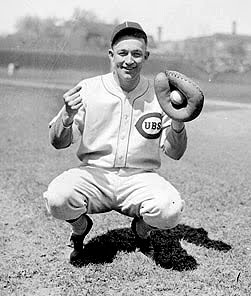
Gabby Hartnett,
1935

     The National League’s catcher in the first five All-Star games, Gabby Hartnett contributed mightily to Cub pennants in 1932, 1935, and 1938. His best year was 1935, when he belted 13 homers, drove in 91 runs, and batted .344. Thanks to his deadly throwing arm, he also led the league’s catchers in assists with 77, despite catching only 110 games. Hall of Fame pitcher Burleigh Grimes said Hartnett had "as good an arm as ever hung on a man."
     On September 4, 1935, the Cubs were in third place behind the Cardinals and Giants. They lost only twice thereafter—on the second-to-last and last days of the season. In between they pulled off an unbelievable 21-game winning streak that catapulted them to the pennant. "All of a sudden we got the notion that we couldn’t lose,” said second baseman Billy Herman.
     Hartnett was the team’s heart and soul for 19 years. He batted .297 for his career and caught over 100 games 12 times—leading the league in putouts four times, in assists six times, and in fielding percentage six times. In 1938, he was appointed player-manager shortly after the midpoint of the season, with the Cubs in fourth place. After going 14-15 for the first month under Hartnett, the team surged to a 30-12 record the rest of the way and won another pennant. Manager Hartnett was helped immeasurably by player Hartnett, whose game-winning home run in the dark on September 28 put the Cubs in first place to stay. It remains arguably the greatest moment in Cubs history.
     Hartnett was elected to the Hall of Fame in 1955.