Wednesday, March 31, 2010

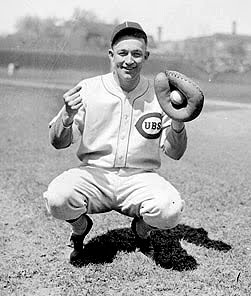
Splendid Seasons: Cubs MVPs, Part 1

We're remembering the 19 Chicago athletes whose splendid seasons have earned them the Most Valuable Player award for their respective leagues. Nine of these players have represented the Cubs, and the first three of them are introduced below.


Wildfire Schulte,
1911

     On the Cubs’ pennant-winning teams of 1906, 1907, 1908, and 1910, right fielder Frank "Wildfire" Schulte was overshadowed by teammates who included the immortal pitcher Mordecai "Three-Finger" Brown and the famed double-play combo of Joe Tinker, Johnny Evers, and Frank Chance. Schulte was adequate in all phases of the game and exceptional in none—until 1911, when he had a year that no one could have predicted. The term “career year” comes to mind. Schulte hit an even .300, belted 21 home runs (along with 30 doubles and 21 triples), scored 105 runs, and drove in 121. He led the league in homers, RBIs, and slugging percentage.
     Although the Cubs finished second to the Giants, Wildfire won the first official National League Most Valuable Player award for his efforts. The trophy was a brand-new car, because the Chalmers Motor Company sponsored the award.
     Schulte’s 21 round trippers marked the first time in modern major-league history that anyone had hit more than 16 in a season. To put the feat in perspective, consider that totals of 10, 12, 7, 10, and 10 had led the league in the five previous seasons. This was, after all, the dead-ball era. Frank “Home Run” Baker of the Philadelphia Athletics, whose nickname (of course) referred to his long-ball prowess, topped the American League with 11 that same year.
     Wildfire soon reverted to the form that made him solid yet unspectacular for 14 of his 15 years in the majors. In the seven years prior to 1911, his best seasonal totals had been 10 homers and 68 RBIs. In the seven years after 1911, his best totals were 13 and 72. He was a .270 hitter for his career.


Rogers Hornsby,
1929

     “Baseball is my life,” said Rogers Hornsby, “the only thing I know and can talk about, my only interest.” He was, as they say today, focused. He didn’t smoke or drink—nor did he read or go to movies, for fear he’d ruin his eyesight. "If you live like I do," Hornsby told teammates, "you can be a great player too."
     Hornsby batted .358 for his career, second only to Ty Cobb in baseball history. He won six straight batting titles for the St. Louis Cardinals from 1920 to 1925, hitting .397 over that span. His single-season mark of .424 in 1924 is an unapproachable standard. But it was not only for his batting feats that Hornsby was exceptional; he was one of the most arrogant, obnoxious personalities the game has ever seen. Despite his incredible ability, he was traded three times in three years after leading St. Louis to the 1926 world championship.
     The 1929 Cubs were Hornsby’s fourth team in four years—and what a team they were! They outscored their opponents by over 200 runs as they breezed to the pennant by 10½ games. Hornsby batted .380, with 229 hits, 47 doubles, 39 homers, 156 runs, and 149 RBIs. Outfielders Hack Wilson (.345, 135 runs, 159 RBIs), Riggs Stephenson (.362, 110 RBIs), and Kiki Cuyler (.360, 43 stolen bases, 111 runs) were other mainstays in the Cubs’ fearsome lineup.
     It was the last great year for Hornsby. In 1930, an ankle injury limited him to 104 at-bats. Wilson’s 191 RBIs established a major-league record that still stands, but the Cubs fell two games short of the Cardinals. In the waning days of the season, Hornsby replaced manager Joe McCarthy (who went on to win eight pennants and seven world championships with the Yankees, but that's another story). The Rajah's managerial tenure of two years was not a success, because, as shortstop Woody English explained, “He expected everybody to be as good as he was.”
     Hornsby was elected to the Hall of Fame in 1942.


Gabby Hartnett,
1935

     The National League’s catcher in the first five All-Star games, Gabby Hartnett contributed mightily to Cub pennants in 1932, 1935, and 1938. His best year was 1935, when he belted 13 homers, drove in 91 runs, and batted .344. Thanks to his deadly throwing arm, he also led the league’s catchers in assists with 77, despite catching only 110 games. Hall of Fame pitcher Burleigh Grimes said Hartnett had "as good an arm as ever hung on a man."
     On September 4, 1935, the Cubs were in third place behind the Cardinals and Giants. They lost only twice thereafter—on the second-to-last and last days of the season. In between they pulled off an unbelievable 21-game winning streak that catapulted them to the pennant. "All of a sudden we got the notion that we couldn’t lose,” said second baseman Billy Herman.
     Hartnett was the team’s heart and soul for 19 years. He batted .297 for his career and caught over 100 games 12 times—leading the league in putouts four times, in assists six times, and in fielding percentage six times. In 1938, he was appointed player-manager shortly after the midpoint of the season, with the Cubs in fourth place. After going 14-15 for the first month under Hartnett, the team surged to a 30-12 record the rest of the way and won another pennant. Manager Hartnett was helped immeasurably by player Hartnett, whose game-winning home run in the dark on September 28 put the Cubs in first place to stay. It remains arguably the greatest moment in Cubs history.
     Hartnett was elected to the Hall of Fame in 1955.

Monday, March 29, 2010

Pro Football Comes of Age


In the above photo, Red Grange of the Bears carries the ball against the Chicago Cardinals at Wrigley Field on November 26, 1925. As might be expected after 85 years, the uniforms of the players and officials look almost nothing like those of today. Look closely, though, and you see that the Bears are sporting the triple stripes on their sleeves that remain to this day. You also see that the idea of watching a game at Wrigley Field from a Sheffield Avenue rooftop is not new.

     On November 22, 1925, the Bears blanked the Packers 21-0 at Wrigley Field. Observing from the Bears’ bench was Harold “Red” Grange, the Wheaton native whose sensational career at the University of Illinois had concluded less than 24 hours earlier. Immediately after the Illini’s season-ending 14-9 victory at Ohio State, the three-time All-American had secretly boarded a train for Chicago to join the Bears. Thus he was at their game the very next day—but not in uniform, because the final details of his contract had not been settled.
     When Grange officially signed with the Bears on Monday morning, it was a monumental coup for Bears owner and head coach George Halas. He announced that “the Galloping Ghost” would make his debut on November 26, Thanksgiving Day, against the Cardinals. Tickets went on sale Monday afternoon, and the 20,000 that had been printed were sold within three hours. Mounted police were called to quell a potential riot among fans who were still in line when the supply ran out. More tickets were printed the following day, and another 16,000 were sold.
     Thursday afternoon was damp and chilly, but Wrigley Field was filled to the rafters. Seventeen people were arrested outside the park for selling counterfeit tickets. Grange took the field wearing a Bears jersey onto which his familiar No. 77 had been hastily stitched.
     In the first quarter, Grange brought the fans to their feet when he fielded a punt and zigzagged 30 yards before being wrestled down. The rest of his afternoon was less eventful. He ended up with 66 yards on three punt returns and 36 yards on 13 carries from scrimmage. He also attempted six passes, all of which fell incomplete, and caught one pass. His interception thwarted one of the Cardinals’ two scoring threats (the other was a field-goal attempt by Paddy Driscoll that ricocheted off one of the uprights).
     Although the Bears failed to mount a serious assault on the Cardinal goal line and the game ended in a scoreless tie, no one seemed too disappointed. When the gun sounded, Cardinal players lined up to shake Grange’s hand, knowing that his presence in the league was likely to make them all more prosperous. Hundreds of fans swarmed onto the field, and only quick work by a cordon of policemen saved Grange from being stampeded by the well wishers.
     “The Bears and the Cardinals are great pro teams,” the Tribune’s Don Maxwell wrote the next morning. “They have thousands of enthusiastic followers. But the more than 36,000 folks who made the turkey wait until the game was over weren’t there to see their teams play. They were there to see the redhead of Wheaton. They cheered when Grange gained ground; they cheered when he lost ground. They went into vocal hysterics when he trotted on the field, and they almost mobbed him when he left it.”
     To exploit Grange’s tremendous popularity, the Bears played exhibition games in St. Louis, Washington, and Pittsburgh in addition to their five regularly scheduled league games between December 2 and December 13—for a total of eight games in 12 days. Late in December, they set off on a coast-to-coast barnstorming tour that saw them play nine more games before the end of January. As a result of these games, Halas said, “Pro football for the first time took on true national stature.”
     Pro football was here to stay. By the time of his death in 1983, Halas had seen the value of an NFL franchise increase from $100 to roughly $100 million. He had also done more than anyone to make it happen.

Excerpted from Heydays: Great Stories in Chicago Sports
(c)2009, 2010 by Christopher Tabbert

Friday, March 26, 2010

Cougar Town


     The Chicago Cougars were the first and presumably the last professional sports franchise to represent the northwest suburb Mt. Prospect. Likewise, the 1974 Avco Cup final series was the first and presumably the last championship of a professional sports league to be played in Mt. Prospect.
     The Cougars were members of the World Hockey Association, which was founded in 1972 as a rival to the National Hockey League, and the Avco Cup was the WHA's equivalent of the Stanley Cup. Like other upstart sports leagues which have come along over the years, the WHA was initially regarded as something of a joke. But the NHL wasn't laughing after Blackhawks superstar Bobby Hull signed with the new league before its inaugural season. Hull's defection to the Winnipeg Jets gave the WHA instant credibility, and 67 other NHL players soon followed.The loss of Hull also proved disastrous for the Blackhawks, marking the beginning of a steady decline in popularity from which they are just now recovering.

     The Cougars finished last in the Western Divison in the WHA's first season, but they made the playoffs the next year, led by three former Hawks: center Ralph Backstrom, defenseman Pat "Whitey" Stapleton, and goalie Dave Dryden. The Cougars won their first two playoff series and advanced to the Avco Cup finals against the Houston Aeros, who featured 46-year-old Gordie Howe—Mr. Hockey himself—and his sons Mark and Marty.
     This was where the sublime met the ridiculous. The Cougars' home arena, the International Amphitheatre at 43rd and Halsted, had been available for the first playoff series, but not for the second series because it had booked a touring production of Peter Pan, starring former Olympic gymnast Cathy Rigby in the title role.
     By the time the Cougars and Aeros were set to start the finals, Peter Pan had moved on—but the Amphitheatre's ice surface had been melted and, for whatever reason, could not be refrozen. The Cougars attempted to shift their home games to Chicago Stadium, but that plan fell through because the Hawks were still alive in the NHL playoffs and weren't willing to share. So, with tails between their legs, the Cougars moved to Randhurst Twin Ice Arena in Mt. Prospect, which was named for the vast shopping mall in whose parking lot it sat.
     The Amphitheatre was no great shakes. In fact, it was decrepit, as anyone who attended one of the many concerts it hosted in those days could attest. But it could seat some 7,000 spectators, whereas the Randhurst rink held less than 2,000. The latter had been designed to suit the needs of participants, not spectators, and it could hardly accommodate newspaper reporters, much less radio and television broadcasts. It was probably just as well, then, that Houston swept the series, and the Cougars were spared the embarrassment of hosting more than two games.
     The shopping-mall ice rink made the Cougars a laughingstock, and they never recovered. During the 1974-75 season, the players themselves chipped in to buy the franchise from original owners Walter and Jordan Kaiser when the brothers failed to secure financing for a new arena in Rosemont. The Cougars folded at the end of that season. The arena in Rosemont was eventually built, of course. It opened in 1980 as the Rosemont Horizon, and it's now known as Allstate Arena. The Randhurst Twin Ice Arena, like the Amphitheatre and the Cougars, is no more.

Postscript: After the Cougars' demise, the World Hockey Association survived for several more years. When it disbanded in 1979, four of its teams joined the NHL: Edmonton Oilers, Hartford Whalers, Quebec Nordiques, and Winnipeg Jets. With them came a number of outstanding players, including Mike Gartner, Michel Goulet, Paul Holmgren, Rod Langway, Ken Linseman, Mike Liut, Mark Messier, Rick Vaive, and the Great One—Wayne Gretzky.

(c)2010 by Christopher Tabbert

Wednesday, March 24, 2010

Splendid Seasons: White Sox MVPs

We're remembering the 19 Chicago athletes whose splendid seasons have earned them the Most Valuable Player award for their respective leagues. Three of these players have represented the White Sox.


Nellie Fox,
1959

     “There was never a more bear-down, hard-nosed little guy than Nellie Fox,” said the great Ted Williams. Fox teamed first with Chico Carrasquel and later with Luis Aparicio to give the White Sox the slickest double-play tandem of the fifties.
     In 1959, leadoff man Aparicio and second hitter Fox supplied the octane for the pennant-winning Go-Go Sox. Aparicio stole 56 bases and scored 98 runs. Fox hit .306 with 70 RBIs, while playing every game (his consecutive-games streak eventually reached 798, a record for second basemen). Both players won Gold Gloves. In the MVP balloting, Fox preceded the man he followed in the batting order, winning the award while Aparicio was runner-up.
     It was no coincidence that Aparicio led the league in steals in each of the seven years that he and Fox played together. Fox was the ideal No. 2 hitter: he could take pitches and foul off pitches all day long without fear of striking out, and he bunted with the best of them. He led the American League for 10 straight years in the category of toughest to strike out. He also led the league in hits four times, played in 12 All-Star games (batting .386), and won three Gold Gloves.
     Fox made an indelible impression on fans with his scrappy, hustling play and the ever-present chaw of tobacco bulging out of his cheek. Listed at five-foot-nine and 160 pounds, Fox never backed down at the plate or in the field. “The most important thing to me,” said teammate Billy Pierce, “was his determination and competitiveness, which made up for some of the physical things he didn’t have. He loved the game and he played it hard.”
     Fox was elected to the Hall of Fame in 1997—but alas, he never knew it, having passed away in 1975.


Dick Allen,
1972

     One of the most talented and enigmatic players of recent decades, Dick Allen used his amazing strength and bat speed to terrorize pitchers in 1972, his first year in the American League after eight seasons in the National League as Richie Allen. Acquired by the White Sox after wearing out his welcome with three other clubs in the previous three years, he came to Chicago with a new name but with the same old attitude. He skipped batting practice, traveled separately from his teammates, and smoked on the bench. He showed up late even for the All-Star Game.
     Despite all this, Allen flourished with the Sox—for a time. Manager Chuck Tanner blithely admitted that he had one set of rules for Allen and another for the rest of the team. The recalcitrant slugger responded with a then-club-record 37 homers to go with 113 RBIs and a .308 average as the Sox stayed in contention all year; they finished five and a half games behind Oakland after bottoming out with 106 losses only two years before. A particular highlight was a doubleheader sweep of the Yankees on June 4 before a Bat Day crowd of 51,904 at Comiskey Park. In the nightcap, the Sox were trailing 4-2 in the bottom of the ninth when Allen blasted a three-run pinch-hit homer into the upper deck in left field.
     Allen used the heaviest bat in the majors, a 42-ounce war club, and launched the most wicked line drives. He literally hit the ball through the back of a wooden seat on more than one occasion. He always wore a batting helmet in the field, a reminder of his days in Philadelphia, where fans pelted him with coins, batteries, and even bottles. White Sox fans showered Allen only with love, but even so, his limited attention span finally gave out in 1974, his third year in Chicago. He quit the team with three weeks left in the season.


Frank Thomas,
1993, 1994

     Frank Thomas joined the White Sox on August 2, 1990, fully formed as a major-league star. He hit .330 in that first partial season. He never experienced the growing pains typical of rookies. He never suffered through a prolonged slump. It soon became apparent that he was the most dangerous offensive force to come along since Ted Williams, half a century before him. No one since Williams had put up such gaudy numbers so consistently from the start of his career. In his first six full seasons, Thomas batted .327 and averaged 36 homers, 116 RBIs, 106 runs scored, and 121 walks.
     The imposing, six-foot-four Thomas played football at Auburn University, where he was a little-known teammate of Heisman Trophy winner Bo Jackson. When the two were reunited with the White Sox, it was Bo’s turn to be eclipsed. In 1993, Thomas slammed 41 homers, knocked in 128 runs, and batted .317 to earn his first American League MVP award as the Sox won their division by eight games.
     In 1994, the Sox were in first place again and might have been destined for their first World Series in 35 years when a labor dispute ended the season on August 12. For the first time since 1904, there was no World Series. Thomas’s second straight MVP was bittersweet, but comparisons to the immortal Williams didn’t seem far-fetched in light of the Big Hurt’s .353 average, 38 homers, 101 RBIs, 106 runs scored, .494 on-base percentage, and .729 slugging percentage in just 113 games.
     Thomas appeared almost exclusively as a designated hitter after the age of 30, and his production declined rather sharply. He had one more monster year in 2000 as the Sox ran away with the division title; he hit .328 with 43 homers, 143 RBIs, and 115 runs scored, finishing second in the MVP voting. Unfortunately, Thomas missed the Sox' unforgettable 2005 postseason with an injury, and he was let go the following winter. By the end of his career in 2008, he ranked among the top sluggers of all time in every pertinent category. It seems safe to assume that he will soon be enshrined in Cooperstown.

Mildly Interesting Trivia Department: Frank Thomas of the White Sox, 1994 American League MVP, and Jeff Bagwell of the Houston Astros, 1994 National League MVP, were born on the same day—May 27, 1968.

Monday, March 22, 2010

A Long Time Coming

RAY MEYER
For DePaul men's basketball coach Ray Meyer, it was 32 long years between George Mikan's graduation in 1946 and the Blue Demons' return to national prominence in 1978. Now, another 32 years have gone by, and DePaul athletic director Jean Lenti Ponsetto is searching for a new head coach to lead the Demons back to glory. Her future husband Joe was one of the key players who helped turn the program around in Meyer's day. Below is the story of how it happened.

     The George Mikan era at DePaul ended with a lopsided 65-40 victory over Beloit College in the regular-season finale on March 9, 1946.
     Coach Ray Meyer began to face life without the man who would later be voted the greatest player of the first half of the century. “While he was around,” Meyer wrote, “I was a great coach.” For his part, Mikan said of Meyer, “I’d be nothing without him.” The Demons had won 81 of 98 games in the four years and finished third, second, and first in their three postseason tournaments. Now Mikan was bound for greater glory in the pro ranks, while Meyer was destined for decades of obscurity. The 32-year-old coach would see his age double before he and DePaul returned to national prominence.

     Fast forward to March 9, 1978. The Blue Demons have concluded their regular season with 12 consecutive victories and a No. 3 national ranking, and they are awaiting the start of the NCAA tournament. Fame, that fickle companion, has returned to Meyer after all these years. In the meantime, seven Presidents have occupied the White House, and Meyer has gone to work at DePaul day after day with no fanfare and little reward beyond the enjoyment he derives from coaching. He and his wife Marge have raised their six children, all of whom call him “Coach.”
     Since Mikan’s departure, the Demons had made six appearances in the NCAA tournament and five in the NIT. They had also endured a stretch from 1967 to 1973 in which they won 74 games and lost 75. The 1970-71 team, captained by Meyer’s son Joey, inadvertently became the catalyst for DePaul’s return to glory. After the Demons struggled to a record of 8-17, the university responded to the debacle by giving Meyer a recruiting budget and allowing him to hire an assistant coach for the first time. There followed a procession of top-flight players to DePaul: forward Bill Robinzine in 1972; center Dave Corzine, guard Ron Norwood, and forward Joe Ponsetto in 1974; guard Gary Garland and forward Curtis Watkins in 1975; and guard Clyde Bradshaw in 1977.
     Like their forerunners of three decades earlier, the 1977-78 Blue Demons were led by an outstanding big man. At six-foot-11 and 250 pounds, Corzine was more or less the same size as Mikan, and comparisons between the two became inevitable. Meyer considered Mikan to have been quicker and generally more athletic than Corzine, while rating both as exceptionally intelligent and competitive. “There is not a better shooting center in the country,” Meyer said of Corzine. “He’s a better outside shooter than Mikan was. George could take the ball inside, though, and I’d sure like to have him back. I’d move Dave to forward and find a way to keep both of them happy.”
     Of DePaul’s 12 straight wins to end the regular season, the biggest one by any measure was the seventh, on February 12 at Notre Dame. The Demons came into the game at 19-2 and ranked 11th in the nation; the Irish were 16-3 and ranked fourth. This was the game that made people take notice of the resurgent Blue Demons. It was a tough afternoon for Corzine, who was suffering from the flu and was double-teamed every time he touched the ball. He managed 23 points and played the entire game, but it was DePaul’s guards who made the difference in the end.
     “The din in Notre Dame’s Athletic and Convocation center,” Bill Jauss wrote in the Tribune, “defied description.” Regulation play ended with the score tied 61-61. Notre Dame led 68-63 with 90 seconds remaining in overtime when DePaul’s little guys took over. Garland scored off a rebound to make it 68-65. Then Bradshaw stole the ball and took it in for a layup to make it 68-67. As the clock ticked down into the final seconds, Randy Ramsey stole the ball and fired it to Garland in the corner for an open 15-footer—which missed. Bradshaw fouled Rich Branning as the latter grabbed the rebound for Notre Dame, sending him to the foul line for a one-and-one with 10 seconds left. “I was sure I’d blown it,” said Garland.
     But when Branning missed the first free throw, Corzine secured the rebound. “I knew we were out of timeouts,” he said. “I looked up court for the first person I could see open. There he was.” He was Garland, streaking up court. Garland fielded Corzine’s baseball-style pass, dribbled to the top of the key, pulled up and let fly. The shot hit, as they say, nothing but net. Almost simultaneously the buzzer sounded. DePaul had won 69-68. “I knew it was going in,” said Garland, who had gone from goat to hero in 10 seconds. “I definitely felt it.”
     “We don’t know when we’re beaten,” Meyer said proudly.
     Exactly a month after their victory at Notre Dame, the Blue Demons opened the NCAA tournament against Creighton. Thanks to red-hot shooting, Creighton led by 20 points late in the first half and by 14 at halftime, but the Demons kept their composure and doggedly battled back. DePaul eventually won 80-78 on two free throws by the virtually unknown William Dise, who’d come into the game when Watkins fouled out. Corzine notched 19 points and 11 rebounds, but it was the unsung Ramsey, normally a defensive specialist, who sparked DePaul’s comeback. Focused to the point of obsession on Corzine, Creighton’s defenders paid no attention to Ramsey, whose scoring average was four points per game. “I told Randy to shoot!” said Meyer. After scoring his usual two points in the first half, Ramsey tallied 12 points after the intermission. “The best half he ever played,” Meyer said. “Without Ramsey, we wouldn’t have won.”
     Corzine was absolutely unstoppable in the next game as DePaul subdued Louisville 90-89 in double overtime. He made 18 field goals, almost all of which were within several feet of the basket, including the game winner with six seconds remaining. He also went 10-for-10 from the free-throw line. His 46 points gave him 1,879 for his career—nine more than Mikan’s previous school record.
     DePaul was now 27-2 and one win away from the Final Four. To get there, the Blue Demons would have to get past none other than Notre Dame. The rematch with Meyer’s alma mater was a compelling story—more compelling, it turned out, than the game itself. Corzine had dislocated a finger in practice the day before; the injury contributed to his relatively pedestrian output of 17 points and particularly hindered his rebounding. Notre Dame’s 22-8 surge early in the second half transformed a one-point game into a rout. The final score was 84-64. “We just didn’t come back,” said Meyer. “The way they rebounded on us, they just took everything away. The well just ran dry.”

     Corzine’s college career, as well as Ponsetto’s and Ramsey’s, ended with DePaul’s departure from the 1978 NCAA tournament. Unlike in 1946, however, when Meyer had faced the dismal prospect of going forward without Mikan, this time DePaul had another superstar waiting in the wings. He was Mark Aguirre, a chunky, six-foot-six scoring machine from Chicago’s Westinghouse High School and perhaps the most coveted recruit in the country. “Mark was a symbol of the revival of DePaul basketball,” Meyer wrote, “for he was the sort of player we would have had no chance to get in our darkest days just a few years earlier.”
     Aguirre was joined in the starting lineup by holdovers Bradshaw, Garland, and Watkins, and center James Mitchem. His debut on November 25, 1978, at UCLA showed that he was intimidated neither by all the national championship banners hanging from the rafters of Pauley Pavilion nor by the Bruins themselves. On the first play of the game, Aguirre dunked resoundingly over UCLA’s All-American center David Greenwood. He finished with 29 points in a 108-85 loss. “He’s just going to keep getting better and better,” said Meyer. “It’s awfully tough to come onto UCLA’s home court for your opener, but it didn’t faze Aguirre. I don’t think the [Los Angeles] Lakers would have fazed him.”
     After the defeat at UCLA, the Blue Demons won their next four games by an average margin of 22 points. They lost at Wichita State, then won eight in succession. They gathered steam as the season progressed. After two narrow losses in January, the Demons won eight more in a row before hosting Notre Dame on March 2. A boisterous overflow crowd at Alumni Hall saw DePaul upset the No. 2-ranked Irish 76-72. Playing his final home game, Watkins scored 21 points while holding Notre Dame’s leading scorer, Kelly Tripucka, to eight. “You turn on the faucet and expect water to come out,” Meyer said. “You put a uniform on Watkins and expect so many points and so many rebounds.”
     DePaul opened the 1979 NCAA tournament with wins over USC and Marquette, setting up a rematch with UCLA in Provo, Utah, on March 17. From the opening tip, the Demons showed that they were not the same team the Bruins had dispatched in November. Because Mitchem could not handle Greenwood by himself, DePaul abandoned its customary man-to-man defense in favor of a zone. “We have a very active zone,” explained assistant coach Joey Meyer. “The guards go out to cover the passing lanes and make steals.” Indeed, the quickness, athleticism, and general relentlessness of DePaul guards Bradshaw and Garland proved overwhelming as the Blue Demons built a 17-point lead by halftime.
     After the intermission, Meyer and the Blue Demons were somewhat mystified when they emerged from the locker room to a thunderous standing ovation. They later learned that in returning to the floor themselves, the UCLA players had disrupted the performance of a dance troupe from Brigham Young University, which was hosting the game. The previously neutral crowd fervently cheered DePaul’s every move from then on and might have helped the Demons withstand a frantic rally by UCLA in the closing minutes. The Bruins narrowed the gap to two points before Garland’s layup with 10 seconds left decided the outcome. DePaul won 95-91, with the two seniors Garland and Watkins each tallying 24 points. “Now, when I walk down the street,” Meyer said, “people will stop asking, ‘Coach, where’s DePaul?’ Pretty soon, everybody will know.”
     DePaul was in the Final Four, and Meyer was becoming a favorite of even casual fans. His craggy, expressive face, gap-toothed grin, and ample midsection made him unmistakable either in person or on television. He was portrayed in the media as an affable, cuddly old grandpa, and his aw-shucks demeanor in interviews reinforced this impression. If he resented that he was just now being discovered by most of the audience, he never let on.
     In their national semifinal game in Salt Lake City, the Blue Demons discovered why Larry Bird was the college player of the year and, not coincidentally, why Indiana State was undefeated. DePaul battled gamely throughout, and even took a one-point lead with 1:37 remaining, but Bird simply would not be beaten. The blond, six-foot-nine wizard hit 16 of 19 shots, grabbed 16 rebounds, and had nine assists as the Sycamores prevailed 76-74. Between his 35 points and the assists, Bird was directly involved in 70 percent of his team’s scoring. (Indiana State lost the championship game to Michigan State, in the first chapter of the legendary rivalry that Bird and Earvin “Magic” Johnson continued in the NBA for a dozen more years.)
     DePaul was at the peak of its success and notoriety for the next few years. The Blue Demons were arguably more popular than the Bulls in this pre-Jordan period. Meyer was now a beloved elder statesman, basking in the respect of opponents, fans, and the media; he was elected to the Basketball Hall of Fame in 1979, only the fourth active coach to be so honored. Aguirre proved to be the genuine article; his career output of 2,182 points and average of 24.5 per game dwarfed those of Corzine and Mikan, and he was the first player chosen in the 1981 NBA draft. Virtually every DePaul game was now televised, and a crowd of reporters followed the team even on the road. The Demons left the cozy 5,500-seat Alumni Hall at Belden and Sheffield, moving to the Rosemont Horizon, which held 18,000. The trickle of prize recruits coming to DePaul became a torrent. Whereas Meyer’s previous teams had carried the aura of gritty underdogs with perhaps more heart than talent, the new Demons were a bunch of thoroughbreds.

Excerpted from Heydays: Great Stories in Chicago Sports
(c) 2009, 2010 by Christopher Tabbert